Short answer
Replace a tyre in the UAE when the tread reaches the legal minimum of 1.6 mm, when it shows bulges, deep cuts or cracking, or when it is around five years past its DOT date. For better wet braking I recommend replacing at about 3 mm. The federal fine for unfit tyres is AED 500 and 4 black points.
Key takeaways
- The legal minimum tread depth in the UAE is 1.6 mm, which is the height of the wear bars moulded into the main grooves.
- I advise replacing at around 3 mm, because wet braking gets noticeably worse below that.
- Tyres more than five years past their DOT date are commonly rejected at inspection, even with good tread.
- Any sidewall bulge, cut showing cords or deep cracking means the tyre should be replaced, not repaired.
- Driving on unfit tyres carries a federal fine of AED 500 and 4 black points.
A lot of the tyres I take off cars in Dubai still have tread left. They come off because of age, heat cracking or a bulge from a speed bump taken too fast. Other times it is the opposite, and I see tyres worn flush with the wear bars on a car that does 200 km a day on the E11. Both are reasons to replace, and both catch people out.
This guide explains the UAE rules on tread depth and tyre condition, the checks I do on every car before fitting, and how to decide whether you need two new tyres or four.
What is the legal minimum tread depth in the UAE?
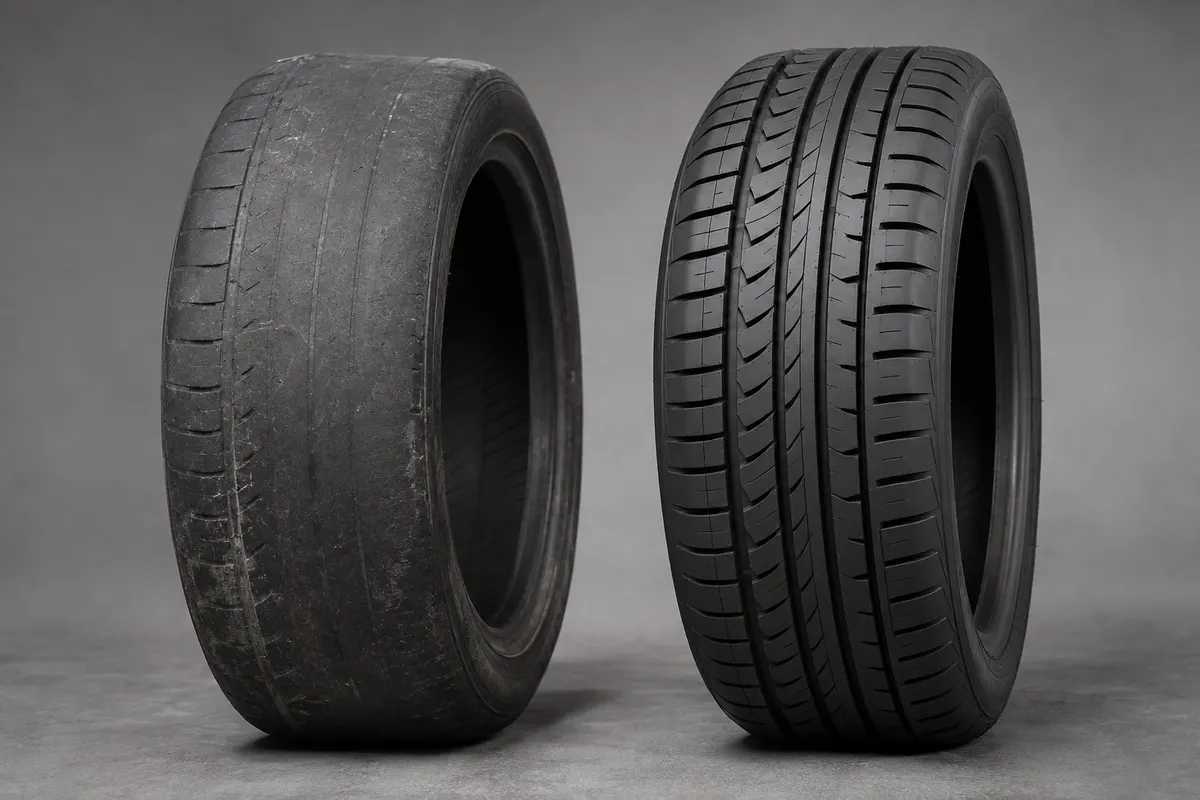
The legal minimum tread depth for car tyres in the UAE is 1.6 mm across the main grooves. That figure matches the standard used across much of the world, and it is the height of the small rubber wear bars moulded into the bottom of the grooves. When the tread surface is level with those bars, the tyre has reached the limit and is no longer roadworthy.
Tread depth matters because the grooves move water away from the contact patch. On dry UAE roads a worn tyre can feel fine, sometimes even grippier, because more rubber touches the road. The problem shows up in the first rain of the season, when oil and dust lift off the asphalt and the road becomes slippery. A tyre near 1.6 mm cannot clear water fast enough, and the car aquaplanes at speeds that would be safe on a newer tyre.
The legal limit is the absolute floor, not a target. Most drivers should plan the replacement well before they reach it. The rule applies to every tyre on the car, so one worn corner is enough for a fine or a failed inspection, even if the other three are new. On cars with wide rear tyres or a strong camber setting, the inner edge can reach the limit while the outer edge still looks healthy, so check the full width, not just the part you can see.
How do I check tyre tread depth at home?
The easiest check is to look for the wear bars in the main grooves and compare them with the tread surface. If the tread is level with the bars anywhere on the tyre, it needs replacing. Most tyres have a small triangle or the letters TWI on the shoulder pointing to where the bars sit.
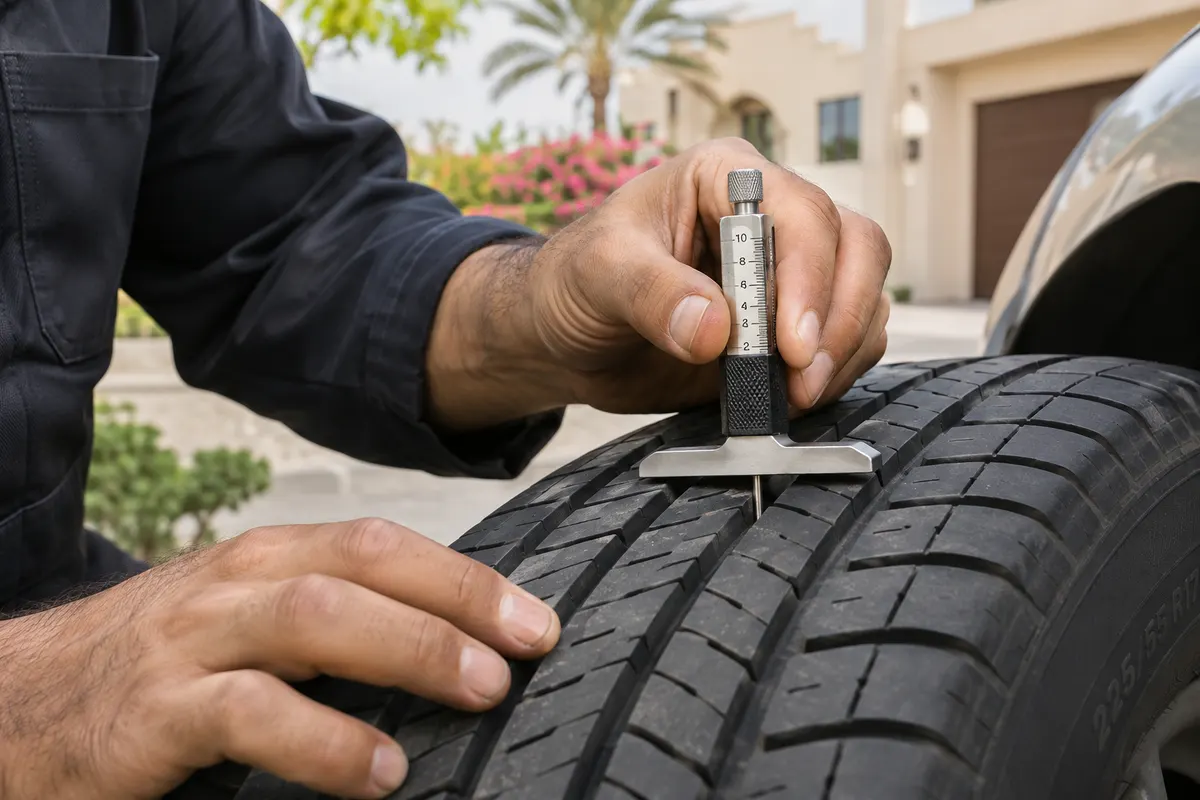
For a more accurate reading, a tread depth gauge costs very little and takes a few seconds per tyre. Measure in at least three places across the width: the inner groove, the centre and the outer groove. Uneven readings tell you something too. Check each tyre, including the spare, and write the readings down. Comparing them a few months later tells you how fast the car is wearing tyres, which helps you plan and budget the replacement rather than finding out at inspection.
- Even wear, low all over: the tyre has simply reached the end of its life.
- Worn on both shoulders: the tyre has been run underinflated, common in summer when people do not recheck pressure.
- Worn in the centre: the tyre has been overinflated.
- Worn on one edge: the wheel alignment is out, often after hitting a kerb or a pothole.
- Patchy or cupped wear: worn suspension or wheels out of balance.
Why should I replace tyres before they reach 1.6 mm?
Wet braking distance increases sharply as tread wears below about 3 mm, so I recommend replacing at that point rather than waiting for the legal limit. Independent tests published in Europe over many years consistently show worn tyres stopping much later in the wet than new ones, and the gap widens as speed rises.
In the UAE that matters in two situations. The first is the handful of rainy days each winter, when roads become slick and accidents spike. The second is high-speed motorway driving, where the margin for error is small at 120 to 140 km/h. A worn tyre is also more likely to puncture, because there is less rubber between a screw or a sharp stone and the casing.
There is a cost argument too. If you replace at 3 mm with a good touring tyre like the PremiumContact 7 or a comfort tyre like the UltraContact UC7, you are not wasting much usable tread. My article on how long Continental tyres last in the UAE explains typical mileage.
How old is too old for a tyre in the UAE?
Tyres more than five years past their DOT date are commonly rejected at inspection in the UAE, even if the tread looks healthy. Rubber ages whether the tyre is used or not, and the UAE climate speeds that up. Ultraviolet light, heat soak in open car parks and the constant flex of daily driving dry out the compound and make it harder and more brittle.
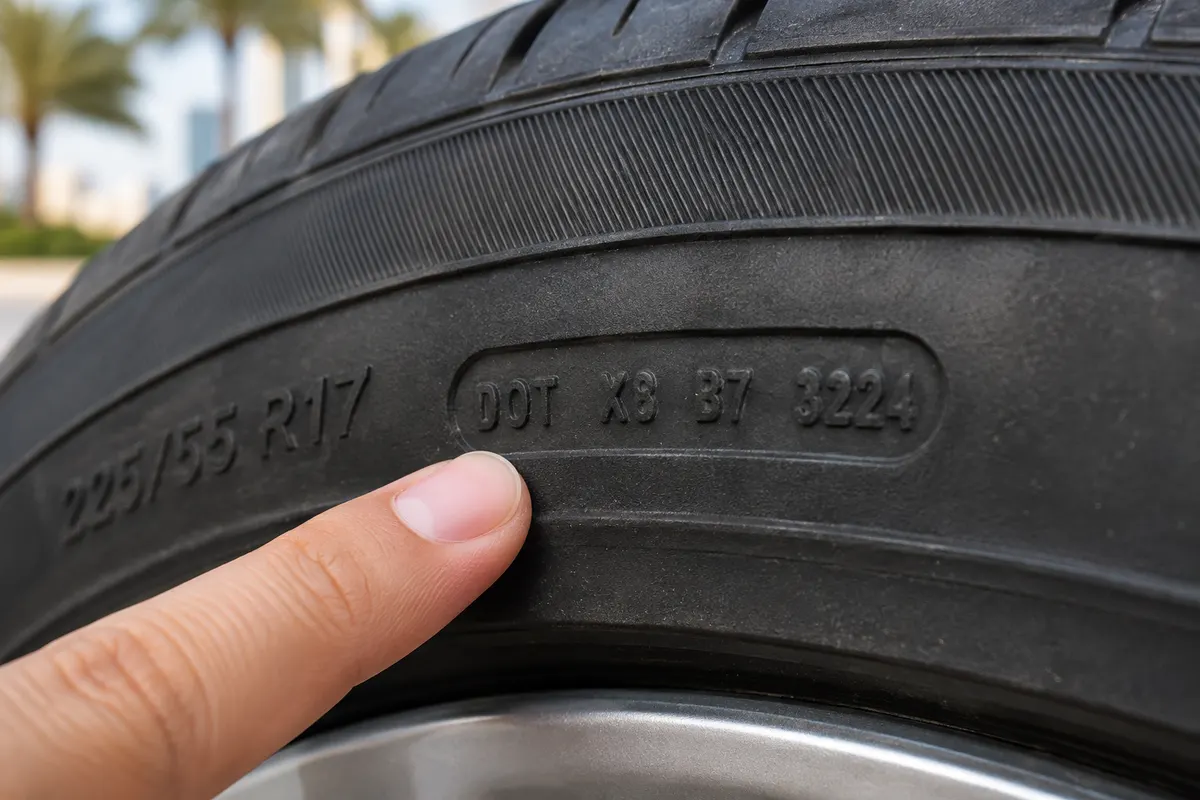
You can find the age in the four-digit DOT code on the sidewall. The first two digits are the week and the last two are the year, so 1424 means the 14th week of 2024. My guide on how to read the DOT date code walks through it with photos.
Pay attention to the spare. Spare tyres often sit unused for many years and are the oldest tyre on the car. They also tend to be the one you need on a hot day on a hard shoulder. When we supply tyres, we show you the DOT code before fitting so you know what you are getting.
Age and tread work together. A five-year-old tyre with 4 mm of tread on a car that sits in a covered car park is in a different state from one that has spent five summers parked outside in Al Quoz. If your tyres are getting close to that age, check them for fine cracks between the tread blocks and on the sidewall, and plan the replacement before the next summer rather than after.
What sidewall damage means a tyre must be replaced?
Any bulge, deep cut, exposed cord or significant cracking in the sidewall means the tyre must be replaced, because sidewall damage cannot be safely repaired. The sidewall flexes with every rotation, and a patch will not hold there. Repairs are only possible in the central tread area, and only for small punctures. In the UAE the most common causes I see are speed bumps taken too fast, kerbs in tight basement car parks and potholes on older service roads. The damage often appears a day or two after the impact, so it is worth checking the tyres if you hit something hard.
- Bulge or bubble: internal cords have broken, often from a pothole, kerb or speed bump. This is the most urgent sign, because the tyre can fail suddenly.
- Cut showing fabric or wire: the casing is exposed and weakened.
- Deep cracking: fine surface crazing is normal on older tyres, but cracks you can push a fingernail into show the rubber has aged past safe use.
- Puncture on or near the shoulder: too close to the sidewall to repair reliably.
- Damage after running flat: if a tyre was driven any distance with no air, the inner sidewall is often destroyed even if the outside looks fine.
What is the fine for driving on unfit tyres in the UAE?
The federal traffic fine for driving with tyres that are unfit for use is AED 500 and 4 black points on your licence. In practice, unfit covers bald tyres, tyres with visible damage and tyres that are not suitable for the vehicle.
Old or worn tyres also cause problems at the annual vehicle inspection, where worn, damaged or aged tyres are commonly a reason for a failed test. That usually means fitting new tyres and returning, which costs more time than replacing them beforehand.
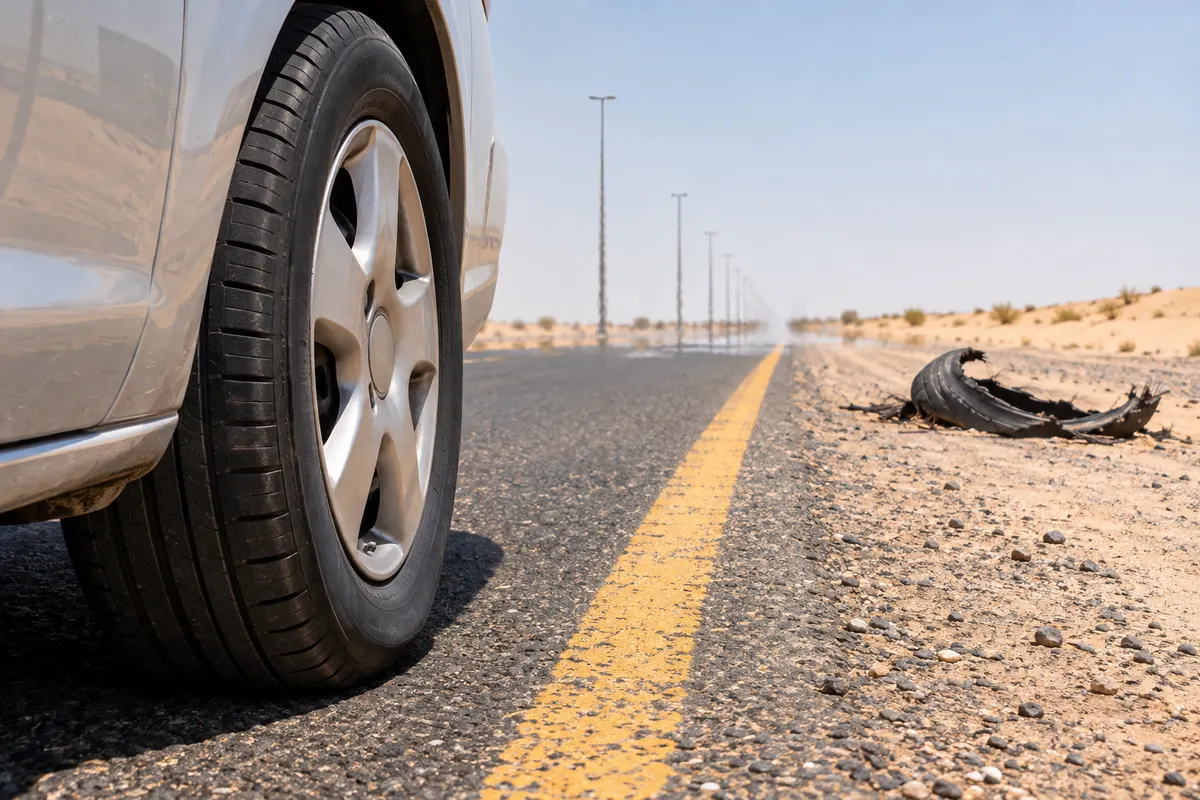
The bigger cost, of course, is the risk itself. In summer I see more blowouts than any other time of year, and old or damaged tyres are behind many of them. My guide to preventing tyre blowouts in UAE summer covers what to check before long drives.
Should I replace two tyres or all four?
Replace all four if they are all close to the limit, or replace the worn pair and fit the new tyres on the rear axle if the others still have plenty of tread. Fitting the better tyres on the rear keeps the car stable in the wet, because a car that loses grip at the rear is much harder to control than one that loses grip at the front.
On four-wheel-drive and all-wheel-drive cars, many manufacturers recommend keeping tread depths close across all four tyres to protect the drivetrain. On those cars, replacing all four at once is usually the right call. For SUVs, the CrossContact LX2 is a common choice for a full set.
Always keep the same model and size on each axle. Mixing patterns or brands across an axle can make the car pull under braking.
The one case where replacing a single tyre makes sense is when the damaged tyre is fairly new and the other tyre on that axle still has nearly full tread. If the difference in tread depth is small, a single matching tyre is fine. If it is large, replace the pair so the car brakes evenly. On many AWD models the manufacturer sets a maximum difference in tread depth between tyres, and the owner's manual is the place to check it.
What happens when you replace tyres with us?
We come to your home, office or building car park, remove the old tyres and fit new Continental tyres with a new valve, balancing on the van, wheel nuts torqued to spec and pressure set to the door-placard value. The old tyres are disposed of. Fitting starts from AED 100 per visit, and tyre prices depend on the size and model.
Before we start, I check the other tyres on the car and point out anything else you should know, such as uneven wear that suggests an alignment problem. If the wear pattern shows the alignment is out, I recommend getting it corrected soon after fitting, because a bad alignment can take months off the life of a new set. You can read more about the tyre replacement service, book Continental tyre fitting at home in Dubai, or check typical Continental tyre prices in the UAE before you message us. Payment by card, cash, Apple Pay, or 4 interest-free payments with Tabby or Tamara. If you are not sure whether your tyres need replacing yet, send a photo of the tread and the DOT code on WhatsApp and I will give you an honest view before you spend anything.