Short answer
In the UAE, Continental comfort and touring tyres typically last 40,000 to 60,000 km, performance tyres such as the SportContact 7 around 20,000 to 35,000 km, and SUV highway tyres 40,000 to 65,000 km. Whatever the mileage, replace them by five years from the DOT date because UAE heat ages rubber quickly.
Key takeaways
- Comfort and touring Continental tyres usually reach 40,000 to 60,000 km in UAE use; ultra-high performance tyres wear out much sooner.
- Age is a hard limit: tyres more than five years past their DOT date are commonly rejected at inspection, whatever the tread.
- Under-inflation, poor alignment and hard launches from traffic lights take more life off a tyre than heat alone.
- Rotating every 8,000 to 10,000 km and checking pressure monthly when cold is the cheapest way to add thousands of kilometres.
How long a set of tyres lasts is one of the most common questions I get while the old ones are still on the car. The honest answer is that it depends far more on the car and the driver than on the badge. I have taken off Continental tyres with plenty of tread at five years old on a weekend car, and I have replaced a set of performance tyres on a powerful sedan at well under 20,000 km.
The ranges below are what I see in practice from four years of fitting and inspecting tyres in Dubai, Abu Dhabi and Sharjah. They are not manufacturer figures or test results, and your tyres can do better or worse depending on the factors further down.
How many kilometres do Continental tyres last in the UAE?
Most Continental car tyres in the UAE last between 35,000 and 60,000 km, with comfort and touring patterns at the top of that range and ultra-high performance patterns well below it. The table further down breaks this out by category.
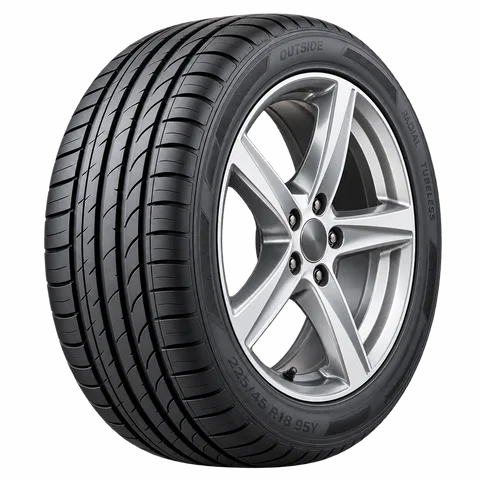
A tyre designed for comfort and long life, such as the UltraContact UC7 on a Camry or Altima, uses a harder-wearing compound and a tread pattern built for even wear. A tyre designed for grip, such as the SportContact 7 on a Porsche or AMG, uses a softer compound that grips better but wears faster, especially on a car with 400 hp or more.
The UAE adds two things. Road surfaces reach 60 to 70°C in summer, which softens the tread and speeds wear. And many drivers cover big distances: a daily Sharjah to Dubai commute or regular E11 runs to Abu Dhabi can put 30,000 km a year on a car, so even a long-life tyre may only last two years. For low-mileage cars it is the opposite, and age becomes the limit long before the tread is gone.
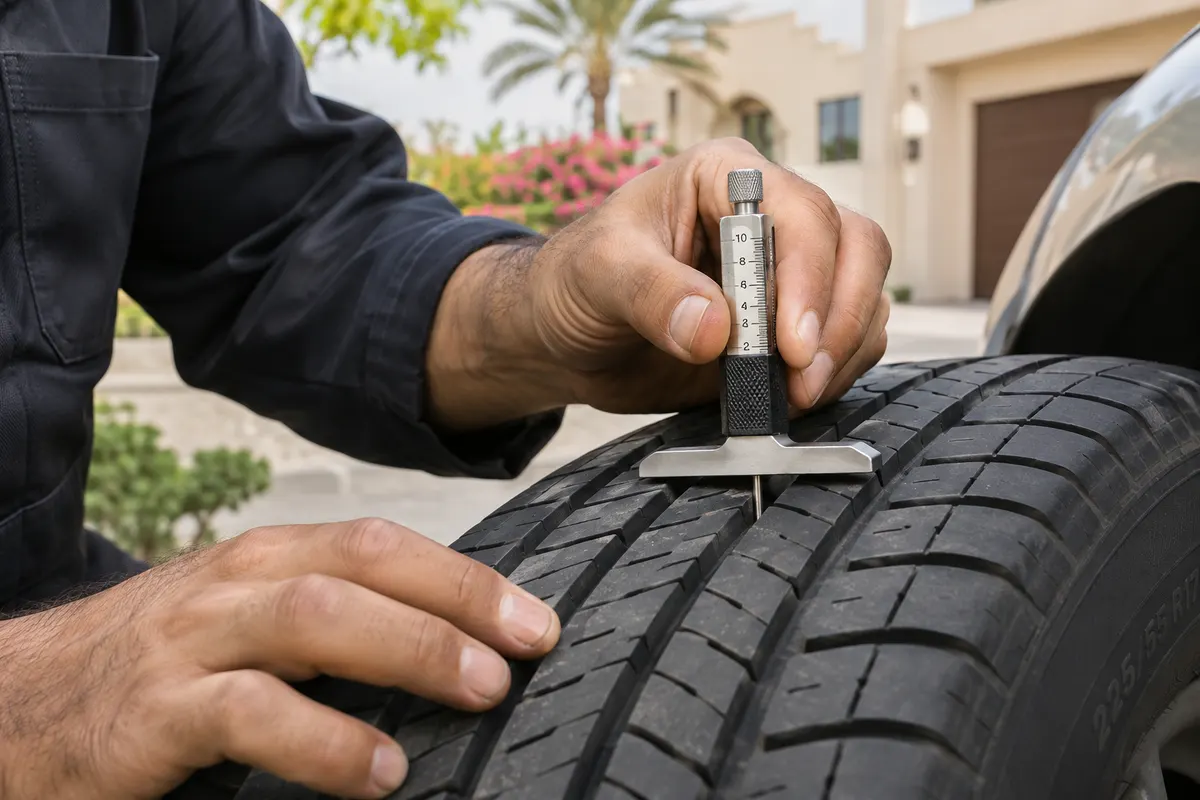
The way I estimate remaining life on a car is simple. New car tyres usually start with around 7 to 8 mm of tread. If a tyre has lost 3 mm in 20,000 km, it is wearing at about 1.5 mm per 10,000 km, and it will reach a sensible replacement point of 3 mm in roughly another 10,000 to 15,000 km. Measure the inner, centre and outer grooves, because the lowest reading is the one that counts.
How many years do tyres last before age becomes the problem?
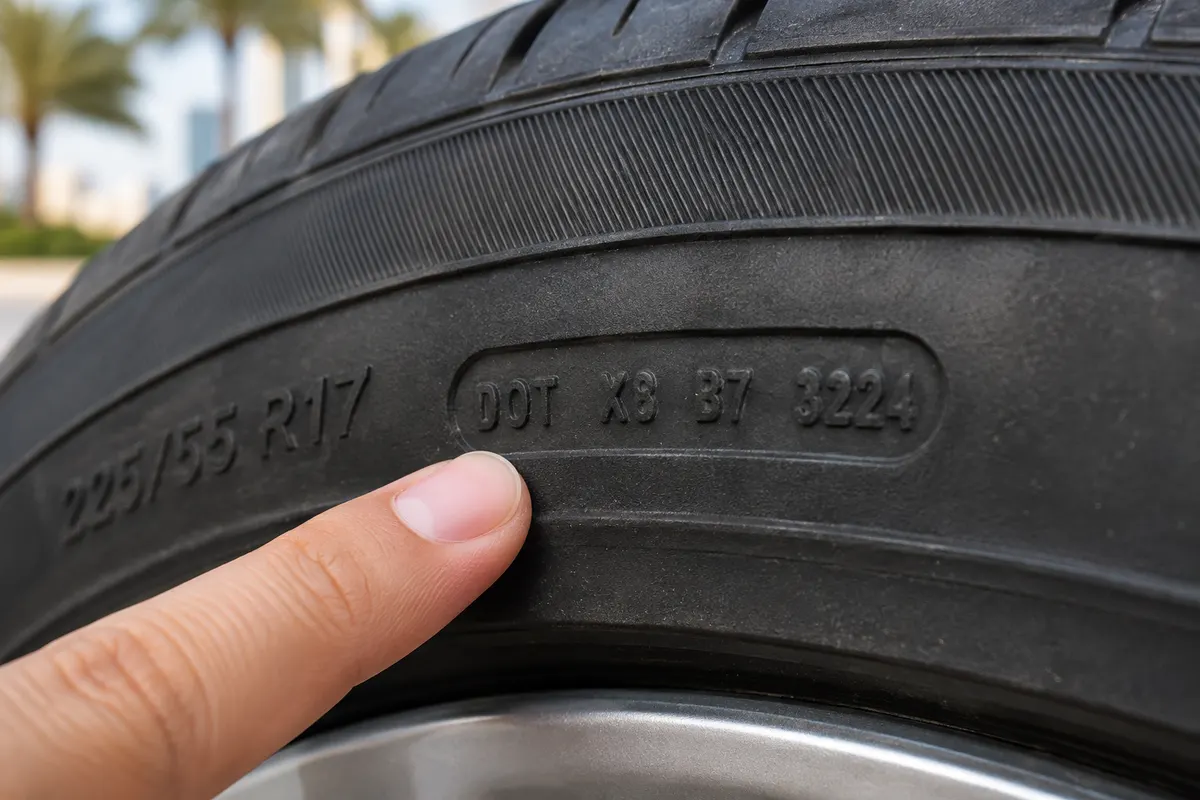
In the UAE, plan on replacing tyres at five years from the DOT date at the latest, because tyres more than five years past their DOT date are commonly rejected at inspection. On cars parked outside, I often see age cracking at four years.
The age clock starts at manufacture, not at fitting. That is why you should check the date before buying; my guide on reading the Continental tyre date code shows exactly where to look.
In practice this gives two kinds of owners. High-mileage drivers wear the tread out first and never meet the age limit. Low-mileage drivers, such as a second family car or a sports car used at weekends, should budget for new tyres on age, and can choose a pattern for grip and comfort without worrying much about tread life.
Where the car is parked matters more than most people think. A car in a covered basement ages its tyres far more slowly than one parked on open ground through the summer. Sun on the sidewalls and heat soak from the asphalt are what cause the fine cracking I see on four-year-old tyres. A sunshade or tyre covers on a stored car help.
What wears tyres out fastest in UAE conditions?
The biggest causes of short tyre life I see are wrong pressure and poor alignment, not the heat on its own. Heat makes both problems worse, because an under-inflated tyre flexes more, runs hotter and wears its shoulders.
Most of these problems are invisible from the driver's seat. A tyre that is 6 psi low looks normal, and inner-edge wear cannot be seen without turning the wheel or getting down beside it. That is why I check pressures and look at the full tread width on every car I work on, not only the tyre being replaced.
The common causes, roughly in order of how often I see them:
- Under-inflation: shoulders wear faster than the centre, and the tyre runs hot on long highway drives.
- Misalignment after kerbs, speed bumps and potholes: one edge of the tyre wears down in a band, often the inner edge where you cannot see it.
- Hard acceleration and braking: launches from traffic lights scrub tread on powerful cars, especially rear-wheel drive.
- No rotation: front tyres on front-wheel drive cars wear far faster than the rears.
- Basement ramps and tight car park turns: full steering lock at low speed scrubs the front shoulders.
- Heavy loads: SUVs loaded for a family trip without raising pressure to the placard's laden value.
| Tyre category | Example Continental patterns | Typical UAE life (km) | Notes |
|---|---|---|---|
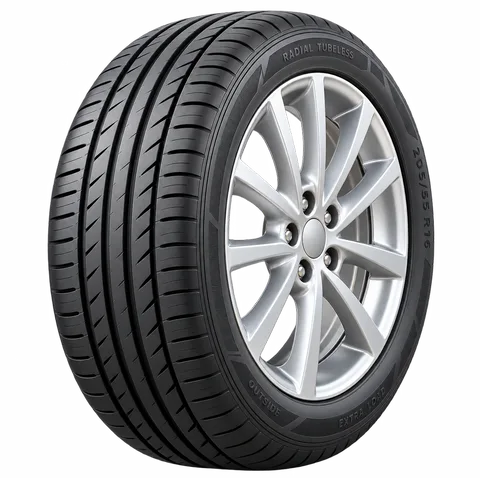
| Comfort / touring | UltraContact UC7, ComfortContact CC7, PremiumContact 7 | 40,000 to 60,000 | Longest life on everyday sedans and hatchbacks |
| Sporty touring | MaxContact MC7 | 30,000 to 50,000 | Softer feel; depends on power and driving style |
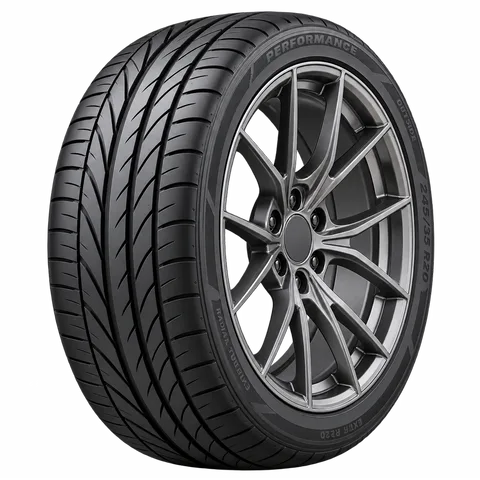
| Ultra-high performance | SportContact 7, SportContact 6 | 20,000 to 35,000 | Rear tyres on staggered RWD cars wear first |
| SUV highway | CrossContact LX2, CrossContact RX | 40,000 to 65,000 | Keep pressure right; heavy vehicles |
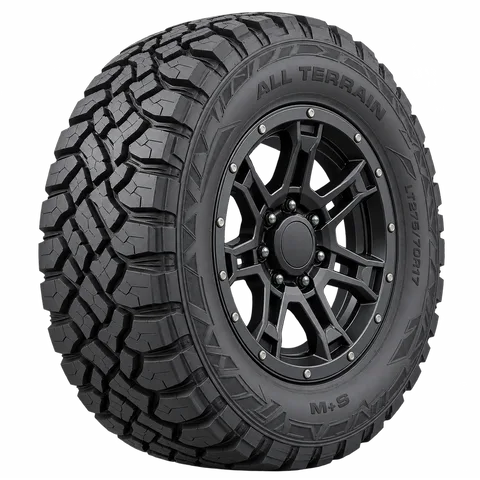
| 4x4 all-terrain | TerrainContact A/T, CrossContact ATR | 40,000 to 60,000 | Sand and gravel chip blocks |
| EV fitments | EV-ready sizes across ranges | About 15 to 25% less than the same tyre on a petrol car | Weight and instant torque |
Do performance tyres like the SportContact 7 wear out faster?
Yes, ultra-high performance tyres such as the SportContact 7 typically last 20,000 to 35,000 km in the UAE, roughly half the life of a comfort tyre. That is the trade-off for grip: a softer compound and a pattern designed for cornering and braking at high speed.
On rear-wheel drive cars with staggered sizes, the rear tyres often wear out at around half the distance of the fronts, and because the sizes differ you cannot rotate front to rear. I advise owners to budget for two rear sets for every front set. For the full picture on this tyre, read my SportContact 7 review.
If you want more life on a sporty sedan and do not track the car, a touring tyre such as the PremiumContact 7 or the MaxContact MC7 in the right size is worth considering. They give up some ultimate grip but are quieter and usually last longer.
Alignment matters more on performance cars than on most. Many have aggressive factory camber settings, and a small knock from a kerb can push the toe out enough to wear the inner shoulder down to the cords while the visible tread still looks fine. On these cars I check the inner edge by hand at every visit, and I recommend an alignment check whenever a new pair goes on.
Do electric cars wear Continental tyres faster?
Electric cars usually wear tyres faster than a similar petrol car, often by around 15 to 25 percent in my experience, because they are heavier and deliver full torque instantly. A Tesla Model Y or a BYD SUV weighs noticeably more than a petrol car of the same size, and that extra weight sits on the tyres every kilometre.
The instant torque is the bigger factor in city driving. A quick pull away from every traffic light scrubs the driven tyres, and on dual-motor cars that means all four. Regenerative braking adds a little more wear on the driven axle too.
Many EV sizes use tyres with a higher load rating, often marked XL or HL, and some come with foam inside to reduce cabin noise. When replacing, match the load index and any EV-specific marking on the original tyre rather than fitting a standard tyre that only matches the size. Smooth acceleration, correct pressure and regular rotation make the same difference on an EV as on any car, and the effect is larger because the starting wear rate is higher.
For typical sizes and what to check, see the electric car tyre page.
How long do SUV and 4x4 tyres last?
Continental SUV highway tyres such as the CrossContact LX2 and CrossContact RX typically last 40,000 to 65,000 km in the UAE, and all-terrain tyres such as the TerrainContact A/T around 40,000 to 60,000 km depending on how much sand and gravel they see.
SUV tyres carry more weight, so pressure matters even more. A Land Cruiser or Patrol run at low pressure for desert driving and then driven back on the highway without reinflating will wear and heat its tyres quickly. Gravel shoulders and rocky wadi tracks also chip tread blocks, which shortens life even if the average tread depth looks fine.
For big SUVs I recommend rotation every 8,000 to 10,000 km and an alignment check once a year. Our page on Continental SUV tyres in the UAE lists the patterns and sizes I fit most often.
One pattern I see often on big SUVs is fast wear on the front shoulders from tight turns in mall car parks and villa driveways. Heavy SUVs on full steering lock at walking pace scrub rubber off the outer edges, so front-to-rear rotation is especially useful on these cars.
How can you make Continental tyres last longer?
The simplest way to make tyres last longer is to keep them at the door-placard pressure, checked cold, every month. Most of the uneven wear I see starts with pressure that has been left to drop.
The routine I suggest to customers:
- Check pressure monthly and before long drives, in the morning before the car has been driven.
- Rotate every 8,000 to 10,000 km on cars where all four tyres are the same size.
- Have alignment checked after a heavy kerb or pothole hit, or if the steering pulls; see our wheel alignment service.
- Take speed bumps slowly and straight, not at an angle.
- Park in shade or covered parking where you can to slow age cracking.
- Replace tyres in axle pairs with the same pattern so they wear evenly.
When should you replace tyres even if they look fine?
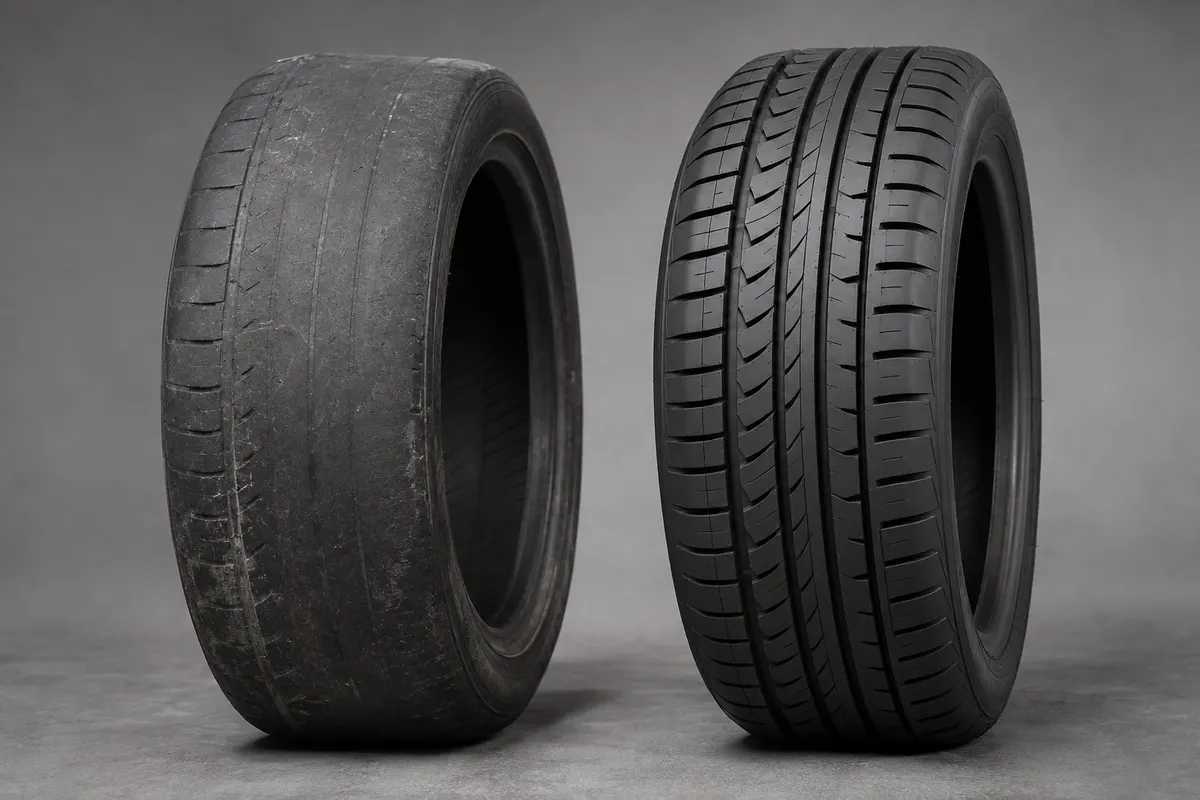
Replace a tyre when tread reaches the 1.6 mm legal minimum, when it reaches five years from its DOT date, or when you see damage such as a bulge, a deep cut or cracks you can catch a fingernail in. Whichever comes first.
The tread wear indicators, small raised bars in the main grooves, sit at 1.6 mm. I suggest changing at around 3 mm on a car that does regular highway runs, because grip in sudden summer rain, on sand-dusted roads and during emergency braking falls noticeably as the grooves get shallow. Coin tests are not reliable for this; a cheap tread depth gauge gives you a real number in seconds.
If you want a rough idea of cost before your tyres reach that point, our guide to Continental tyre prices in the UAE gives typical bands by rim size.