Short answer
The Continental tyre date code is the last four digits of the DOT number on the sidewall. The first two digits are the production week and the last two are the year, so 2324 means week 23 of 2024. The full code with the date appears on one side only, so check both sides.
Key takeaways
- Read the four digits inside the small oval at the end of the DOT code: week first, then year (2324 = week 23 of 2024).
- The full DOT code with the date is moulded on one sidewall only, often the side facing inwards once fitted.
- In the UAE, tyres more than five years past their DOT date are commonly rejected at inspection, so age matters as much as tread.
- A properly stored new tyre up to about two years old performs as new, but ask to see the DOT before it goes on the wheel.
The DOT date code is the first thing I check on every tyre, before the size and before the tread. In four years of fitting tyres in Dubai, Abu Dhabi and Sharjah I have seen cars with deep tread that still needed new tyres because the rubber was seven or eight years old and cracking between the blocks, usually on a car that spent its life in an open parking lot.
The code is easy to read once you know where it is. This guide shows how to find it on a Continental tyre, what each part of the DOT number means, and the age I am comfortable fitting as new in UAE conditions.
Where is the DOT code on a Continental tyre?
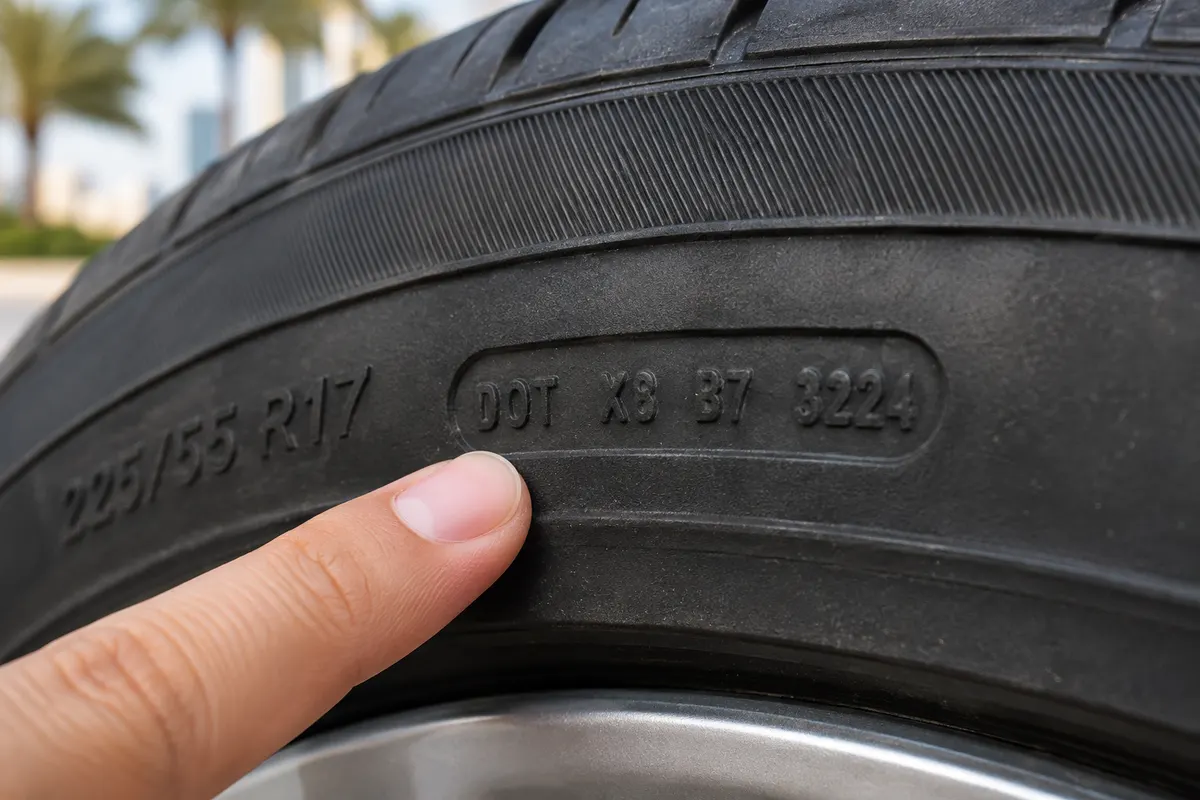
The DOT code is a line of letters and numbers starting with "DOT" moulded into the lower sidewall, close to the rim. On Continental tyres it sits near the size marking and the load and speed index, and it ends with a four-digit number inside a small raised oval. That oval is the date.
The full code, including the date, is only required on one sidewall. The other side often shows a shorter version without the four digits. This catches people out because the full code frequently ends up on the inside face once the wheel is on the car. If you cannot see an oval on the outside, crouch down and look behind the tyre with a phone torch, or turn the steering to full lock on the front wheels so the inner face is easier to see. On rear wheels you may need to look from underneath the bumper.
On a car parked in a tight basement bay it can take a minute. When I fit new tyres I read the DOT off the tyre before it is mounted, while both faces are visible, and I show it to the customer. If you are buying Continental tyres online in the UAE, ask the seller to send a photo of the code first.
How do you read the four-digit date code?
The four digits are week then year: the first two digits are the week of production (01 to 53) and the last two are the year. Tyres made since 2000 use this four-digit format.
Weeks run from the start of January, so week 01 is the first days of the year and week 52 or 53 falls in late December. To turn a week into a month, divide the week number by 4.3: week 23 divided by 4.3 is about 5.3, so the tyre was made in early June. You do not need to be exact; the month and year are enough to judge age.
If the oval shows only three digits, the tyre was made before 2000, when the code used a single digit for the year. You will not see these on a road car today unless it is a classic that has been standing for decades, and those tyres should come off before it is driven anywhere. Some examples:
- 2324: week 23 of 2024, which is early June 2024.
- 0125: the first week of January 2025.
- 4823: week 48 of 2023, late November 2023.
- 1226: week 12 of 2026, around mid to late March 2026.
- A three-digit code such as 359 means the tyre was made before 2000. It should not be on any car today.
What do the other characters in the DOT code mean?
The characters between "DOT" and the date identify where and how the tyre was made, and they are mostly useful for recalls and warranty records. Reading left to right, the first two characters after DOT are the plant code, which tells you which factory built the tyre. Continental makes tyres in many plants worldwide, so the same pattern in the same size can carry different plant codes. That is normal and does not mean one is better.
The next two characters are a size code, and the following group, up to four characters, is a manufacturer's code that can describe the construction or a specific batch. The date oval comes last.
For you as a driver, two things matter. First, the date, which tells you age. Second, writing the whole code down at the time of purchase, because the plant and batch characters are what a distributor uses if there is ever a quality claim. I cover that in more detail in the guide to the Continental tyre warranty in the UAE.
Other markings sit near the DOT code but are not part of it. The size, such as 225/45 R17, is followed by the load index and speed symbol, for example 94Y. XL means extra load construction. A circled E with a number shows European type approval. Car maker OE markings such as MO or a star appear separately on the sidewall. None of these tell you the age of the tyre; only the oval does.
| DOT date code | Week | Year | What it means for you |
|---|---|---|---|
| 0125 | 01 | 2025 | Recent; plenty of life left before the five-year mark |
| 2324 | 23 | 2024 | Made around early June 2024 |
| 4823 | 48 | 2023 | Made late November 2023; check storage if buying new |
| 1521 | 15 | 2021 | Over five years old in 2026; commonly rejected at inspection |
| 359 (three digits) | 35 | Before 2000 | Far too old; replace immediately |
How old is too old for a tyre in the UAE?
In the UAE, tyres more than five years past their DOT date are commonly rejected at vehicle inspection, even when the tread is above the 1.6 mm legal minimum. Rules and inspection practice can change, so treat five years as the working limit rather than a target to stretch.
My own approach is simpler. On a car that sits outside in Dubai or Abu Dhabi, I expect to replace tyres on age somewhere between four and five years, because heat and sun age the rubber faster than in cooler countries. On a car that lives in a covered basement and does short trips, the tyres often reach five years with no cracking at all, but they still come off at five.
Age also matters for safety, not only inspection. An aged tyre loses flexibility, grips less on a hot or dusty surface, and is more likely to fail at 120 to 140 km/h on the E11 in July. The federal traffic fine for unfit tyres is AED 500 and 4 black points, and a blowout costs far more than that. The full set of replacement signs is in my guide on when to replace tyres in the UAE.
Is a new tyre that sat in storage still new?
A new tyre that has been stored correctly, indoors, out of sunlight and away from heat sources, performs as new for at least the first couple of years after its DOT date. Rubber ages much more slowly in a warehouse than on a car, because it is not flexing, not heating up on the road and not baking in the sun.
That said, every month in storage is a month taken off the useful life in the UAE, because the five-year inspection clock starts at the DOT date, not the fitting date. A tyre made two years ago gives you about three years before age becomes an issue. For a low-mileage car that might be fine. For a car doing 30,000 km a year it hardly matters because the tread will wear out first.
What I tell customers: for normal daily use, a tyre up to about 12 months old is what you should expect, and up to 24 months is acceptable if it has been stored well. Beyond that, ask for a fresher batch or a better price. Do not accept a new tyre that shows sidewall cracking, a chalky surface or flat spots from being stacked under weight for a long time; those are signs of poor storage, not just age. We supply tyres with a fresh DOT date and show the code before fitting, so there are no surprises.
How does UAE heat and sun affect older tyres?
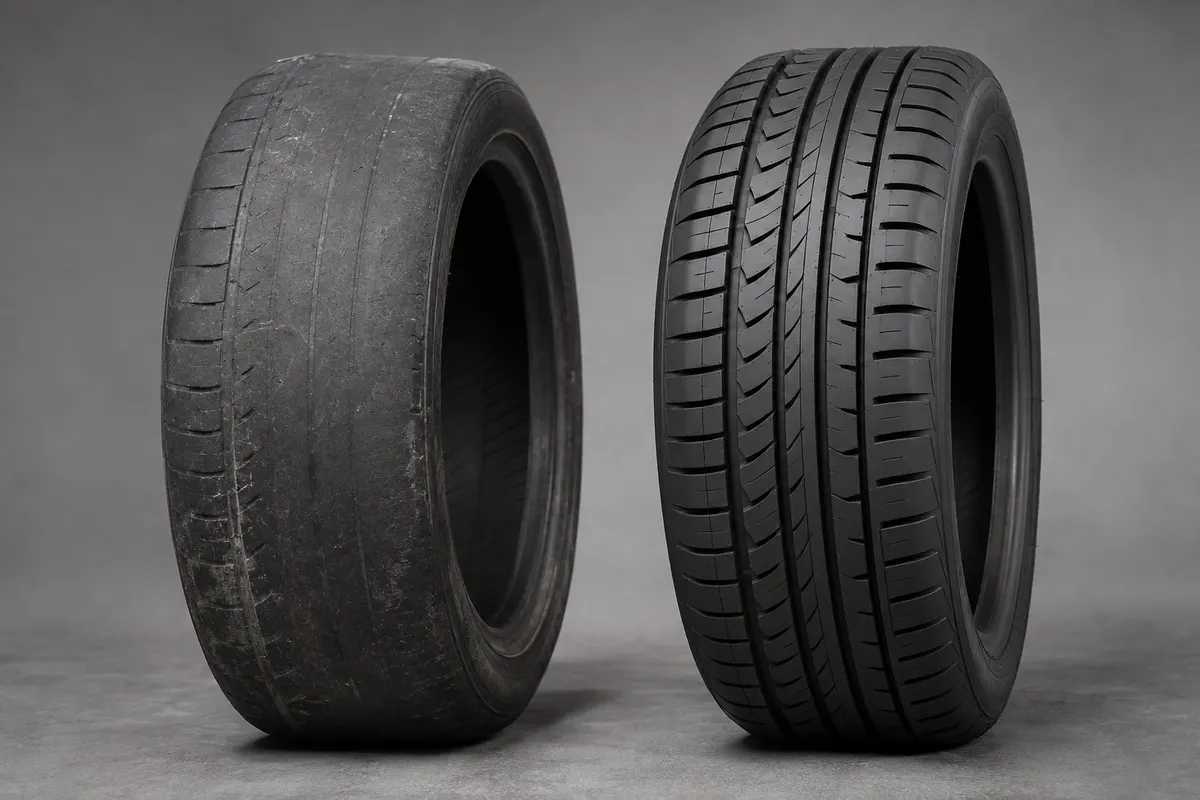
UAE heat speeds up tyre ageing because road surfaces reach 60 to 70°C in summer and UV exposure is high all year. The visible result is fine cracking on the sidewall and in the base of the tread grooves, sometimes called weather checking or dry rot. Light surface crazing on a young tyre is cosmetic, but cracks you can catch a fingernail in mean the tyre is due.
The signs I look for on older tyres:
- Cracks around the sidewall lettering and near the rim line.
- A hard, shiny feel to the tread rather than a slightly soft surface.
- Bulges or uneven shoulders after hitting speed bumps or kerbs in car parks.
- Grip that feels worse on dusty, sandy road surfaces than it used to.
- Tyre pressures that drop faster than they did when the tyres were new.
How old is the spare tyre in your boot?
The spare tyre is often the oldest tyre on the car, because it usually stays from the day the car left the factory. On cars I inspect that are eight or ten years old, it is common to find a full-size spare with perfect tread and a DOT date that matches the car's build year.
An old spare is a real risk in the UAE. You only use it when something has already gone wrong, often on a hot highway shoulder, and a tyre that has aged for years in a boot that gets far hotter than the cabin in summer may not survive a long drive at speed. Space-saver spares are also limited, usually to 80 km/h, and are meant only to get you to a fitter.
Check the DOT on the spare the next time you check your tyre pressures, and check its pressure too, since spares lose air slowly over months. If it is more than five years past its DOT date, replace it or treat it strictly as a short-distance emergency tyre. Our spare tyre service covers fitting a new spare or swapping it in at the roadside.
What should you check before your tyres are fitted?
Check the DOT date, the size and the load and speed index on every tyre before it is mounted, because once it is on the rim the full code may be facing inwards. It takes a fitter less than a minute to show you.
My short checklist when I arrive for a tyre replacement:
- All tyres on the same axle have the same pattern, for example two PremiumContact 7 or two UltraContact UC7, not a mix.
- DOT dates are recent and, ideally, close to each other on the same axle.
- The size, load index and speed rating match the door placard or the car's approved fitments.
- Any OE marking your car needs (such as MO, AO or the BMW star) is on the sidewall.
- The invoice records the DOT code, size and date of fitting, so you have a record for inspection and warranty.