Short answer
In the UAE summer, set tyre pressure to the cold value on your door-pillar placard, checked in the morning before driving. Do not lower it to allow for heat. Pressure rises roughly 1 PSI for every 5 to 6°C, and the tyre is designed for that. Underinflation, not heat alone, is what causes most summer tyre failures.
Key takeaways
- Use the placard pressure, measured cold, and never let air out of hot tyres.
- Pressure changes about 1 PSI for every 5 to 6°C of temperature change.
- Check every two weeks in summer, and before any long highway drive.
- For sand, drop to around 15 to 18 PSI on a 4x4 and re-inflate before returning to tarmac.
- Underinflation builds heat in the sidewall and is the main cause of summer blowouts.
The question I hear most from June to September is whether to let some air out because of the heat. I understand the logic: it is 46°C outside, the tyres feel hot, and the gauge shows a higher number than the sticker. But letting air out of hot tyres is one of the riskiest habits I see in the UAE.
In four years of fitting and checking tyres, most of the summer failures I have dealt with came from tyres running too soft, not too hard. This guide explains how pressure really changes with heat, how to check it correctly, and what to do for sand and long highway trips.
What tyre pressure should you use in the UAE summer?
Use the cold tyre pressure printed on your car's door-pillar placard, all year round, including the summer. That figure is set by the car maker for the car's weight, suspension and tyre size, and it already allows for the pressure rise that comes with heat and driving.
The placard is usually on the driver's door frame, sometimes inside the fuel flap or in the owner's manual. Many placards show two sets of values: one for normal loads and a higher one for full loads or sustained high speed. For a family trip on the E11 with luggage, use the higher figure.
Do not use the number on the tyre sidewall. That is the maximum pressure the tyre can hold, not the pressure your car should run. On most sedans it is far higher than the correct value, and running at it makes the car skittish and wears the centre of the tread.
- Find the placard on the driver's door pillar or fuel flap.
- Use the full-load value for long, loaded highway trips.
- Never inflate to the maximum on the sidewall.
How much does heat increase tyre pressure?
Tyre pressure rises by roughly 1 PSI for every 5 to 6°C increase in temperature, so a tyre set at 33 PSI on a cool morning will read 36 to 38 PSI after a midday drive. This is normal and expected, and the tyre and car are designed for it.
Two things push temperature up in the UAE. First, the air temperature, which can swing from 30°C at dawn to 47°C in the afternoon. Second, driving: a tyre flexes as it rolls and warms itself, typically adding a few more PSI after 20 to 30 minutes on the highway, more on a 65°C road surface.
The opposite happens in winter. On a January morning at 14°C, a tyre set in August will read several PSI low. I see many TPMS warnings in the first cool week of December for exactly this reason, and in the same weeks I also see more cars with visibly soft tyres that the owner had not noticed. That is a reminder to top up, not a fault.
Here is a practical example. A Patrol set to 35 PSI at 6am in a 32°C Dubai morning may read about 37 to 38 PSI by early afternoon parked in 46°C sun, before it has moved. After an hour on the E11 it could read 40 PSI or more. All of those readings are normal for a tyre that was correct when cold.
Should you let air out of tyres when they are hot?
No, you should never let air out of tyres when they are hot. A hot tyre's reading is temporarily high, and once it cools, the pressure will drop below the correct value, leaving the tyre underinflated for the next drive.
An underinflated tyre flexes more in the sidewall, and that flexing creates heat. On a summer highway at 130 km/h, that is how a sidewall overheats and fails. Most of the blowouts I have seen on the E311 and E11 involved tyres that were soft, overloaded, old or all three, not tyres that were inflated to the placard.
If you have to check during the day, accept that the reading will be higher than the placard and only add air if it is still below the cold figure. Better still, check in the morning or after the car has been parked in shade for at least three hours. My post on preventing tyre blowouts in a UAE summer covers the other warning signs.
- Hot readings are normally 3 to 5 PSI above cold.
- If a hot tyre reads below the placard, it is seriously underinflated: add air.
- Check cold, after the car has been parked for 3 hours or more.
| Vehicle type | Typical cold PSI (normal load) | Highway, loaded | Sand |
|---|---|---|---|
| Small hatchback or compact sedan | 32–35 | Placard full-load value, often 35–38 | Not recommended |
| Mid-size or large sedan | 33–36 | Placard full-load value, often 36–40 | Not recommended |
| Electric car | 38–42 | Placard value, often 42 | Not recommended |
| Crossover or mid-size SUV | 33–36 | Placard full-load value, often 36–40 | 18–20, short stretches only |
| Large 4x4 (Patrol, Land Cruiser) | 32–35 | Placard full-load value, often 35–38 | 15–18 |
| Pickup truck | 35 front / 35–44 rear | Placard laden rear value | 15–18 unladen |
| Van or MPV | 35–45 (C-rated tyres higher) | Placard laden value | Not recommended |
How often should you check tyre pressure in the UAE?
Check tyre pressure at least every two weeks in summer, and once a month in the cooler months, plus before any long drive. All tyres lose a little air naturally, often around 1 PSI a month, and heat and rough roads speed that up.
I recommend a simple digital gauge kept in the glovebox. Petrol station gauges are convenient but not always accurate, and the car is rarely cold by the time you reach one. A good digital gauge costs little and lasts for years, so it pays for itself quickly. TPMS is helpful, but most systems only warn when a tyre is around 20 to 25% below the target, which is already low enough to affect handling and heat build-up.
If you would rather not do it yourself, our tyre pressure check service starts from AED 100 and includes a visual check of the tread, sidewalls and valves at your home or office. Cars parked in cool basements and then driven into 45°C heat benefit most from regular checks, because the swing is bigger.
A good habit is to link the check to something you already do. Some customers check on the first and fifteenth of each month, others every second fuel stop or charge. The exact routine matters less than doing it consistently, especially from May to October.
What tyre pressure should you use for sand and desert driving?
For soft sand, most 4x4 drivers in the UAE lower their tyres to around 15 to 18 PSI, which lengthens the contact patch and helps the tyre float instead of dig. Exact values depend on the vehicle weight, tyre size and sand conditions, but this range is a safe starting point for a Patrol, Land Cruiser or Wrangler.
Lower pressure means more sidewall flex, so drive gently. Keep speed low, avoid sharp turns that can pull a tyre off the bead, and do not run on tarmac at sand pressure. Re-inflate to the placard value before you return to the road, even for a short distance. A portable compressor and a reliable gauge are essential kit for any desert trip, even a short one.
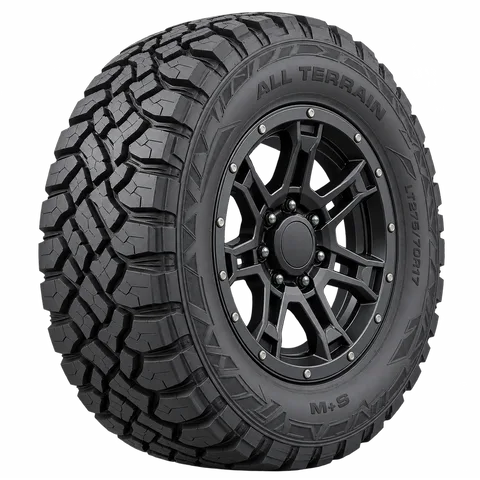
Tyre choice also matters. An all-terrain pattern with a strong casing, such as the TerrainContact A/T, handles low-pressure sand work better than a road-focused tyre. My guide to the best Continental tyres for desert driving and our off-road tyres page cover this in more detail.
- Soft sand: around 15 to 18 PSI on most 4x4s.
- Very soft dunes: experienced drivers sometimes go lower, at very low speed.
- Re-inflate to the placard value before driving on tarmac.
Is nitrogen better than air for tyres in the UAE?
Nitrogen is safe and loses pressure slightly more slowly than normal air, but it is not necessary and does not replace regular checks. Normal air is already about 78% nitrogen, so the real-world difference for a road car is small.
The benefit people expect is that nitrogen will stop pressure rising in the heat. In practice, nitrogen and air behave almost the same way when warmed, so a nitrogen-filled tyre still gains roughly 1 PSI per 5 to 6°C. What nitrogen can do is reduce moisture inside the tyre and slow the natural seepage a little.
If you already use nitrogen, you can top up with normal air when needed. Mixing them is completely safe, and the gauge reading is what counts either way. I would rather a customer checks normal air every two weeks than fills with nitrogen and forgets about the tyres for six months.
How does correct pressure affect tyre life and fuel use?
Correct tyre pressure gives the longest tread life, the most even wear, the best fuel economy or EV range and the shortest braking distances. Being just a few PSI off changes the shape of the contact patch and how the tread wears.
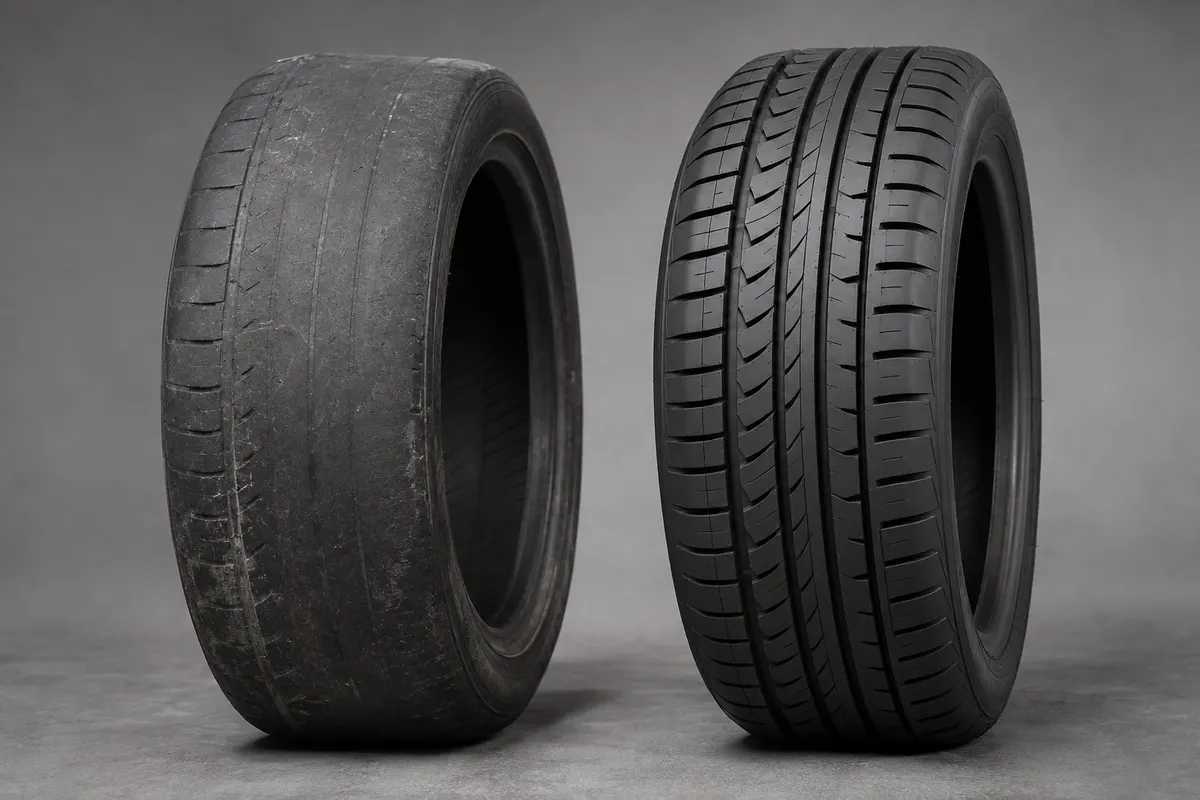
Underinflated tyres wear both outer shoulders and use more fuel, because the rolling resistance goes up. Overinflated tyres wear the centre strip, give a harsher ride over speed bumps and have a smaller contact patch, which lengthens braking on wet or dusty roads. Both shorten the life of an expensive set. Uneven pressure between left and right can also make the car pull to one side, which many drivers mistake for an alignment problem.
I see the effects clearly on comfort tyres like the CrossContact LX2 and touring tyres on family cars: sets kept at the right pressure wear flat and even, while neglected ones need replacing thousands of kilometres early. After every fitting, we set the pressure to the placard value, but holding it there is down to regular checks. You can book a Continental tyre fitting at home and we will show you the correct values for your car.
How do you check tyre pressure correctly?
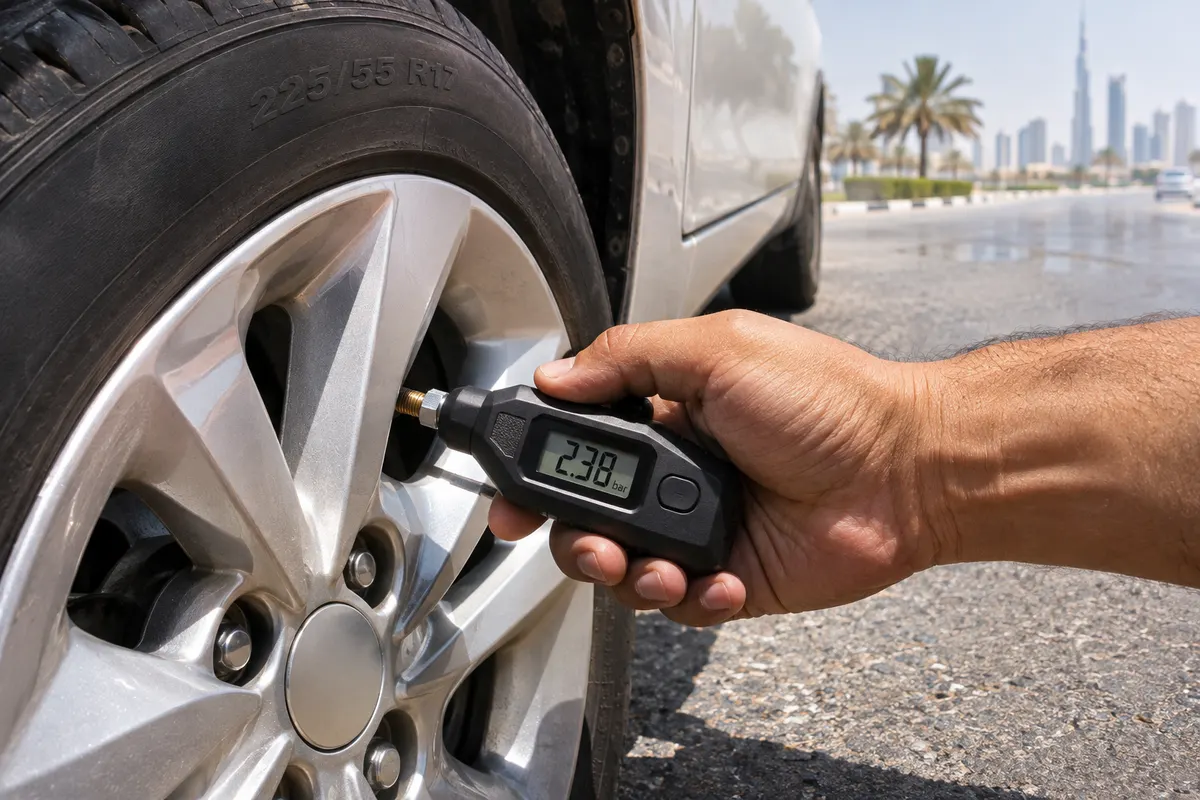
To check tyre pressure correctly, use a reliable gauge on cold tyres, compare the reading with the placard and adjust in small steps. The whole job takes about five minutes for four tyres and the spare.
First, make sure the tyres are cold, meaning the car has not been driven for at least three hours or has only moved a short distance at low speed. Remove the valve cap, press the gauge firmly onto the valve so no air hisses out, and read the figure. Add air in short bursts and recheck, or press the valve core briefly to release air if the tyre is above the placard value when cold.
Do not forget the spare wheel if your car has one. I regularly find spares at 15 to 20 PSI, which is no help when you need them. A compact spare often has a much higher pressure, sometimes 60 PSI, which is printed on its own sidewall or the placard.
Finally, refit the valve caps. They keep dust and sand out of the valve core, which is a common cause of slow leaks in the UAE. While you are at each wheel, look for nails, cuts, bulges and uneven wear, and book a check if anything looks wrong.
- Check cold, with your own digital gauge.
- Compare with the placard, not the sidewall maximum.
- Include the spare, and refit every valve cap.