Short answer
For UAE desert driving, an all-terrain tyre such as the Continental TerrainContact A/T or CrossContact ATR is the best balance of sand flotation, sidewall strength and highway comfort. Whatever tyre you fit, lower the pressure to around 15 to 18 PSI in soft sand and re-inflate to the door-placard value before driving back on tarmac.
Key takeaways
- All-terrain patterns like the TerrainContact A/T and CrossContact ATR suit drivers who do the dunes regularly and still drive the E11 or E311 daily.
- The Conti4x4Contact and TerrainContact H/T are highway-first tyres that cope with graded tracks and occasional sand, not serious dune work.
- Tyre pressure matters more than tread pattern in soft sand: around 15 to 18 PSI for most 4x4s, back to placard pressure before tarmac.
- Heat is the hidden enemy. Low pressure plus 60°C sand plus highway speed is how sidewalls fail.
- Check for sidewall cuts, embedded stones and bead damage after every desert trip.
Most of the 4x4 tyres I replace after the winter dune season are not worn out. They are damaged. Sidewall cuts from rocks hidden under the sand near Fossil Rock, tyres that came off the bead at Al Qudra because the pressure went too low, and tyres that were driven home on the E44 at sand pressure and overheated. The tread was fine on almost all of them.
So when someone asks me which Continental tyre is best for the desert, I answer in two parts: the tyre itself, and how you run it. This guide covers both, based on what I see when I fit and inspect 4x4 tyres in Dubai, Abu Dhabi and Sharjah.
What makes a tyre good for desert driving in the UAE?
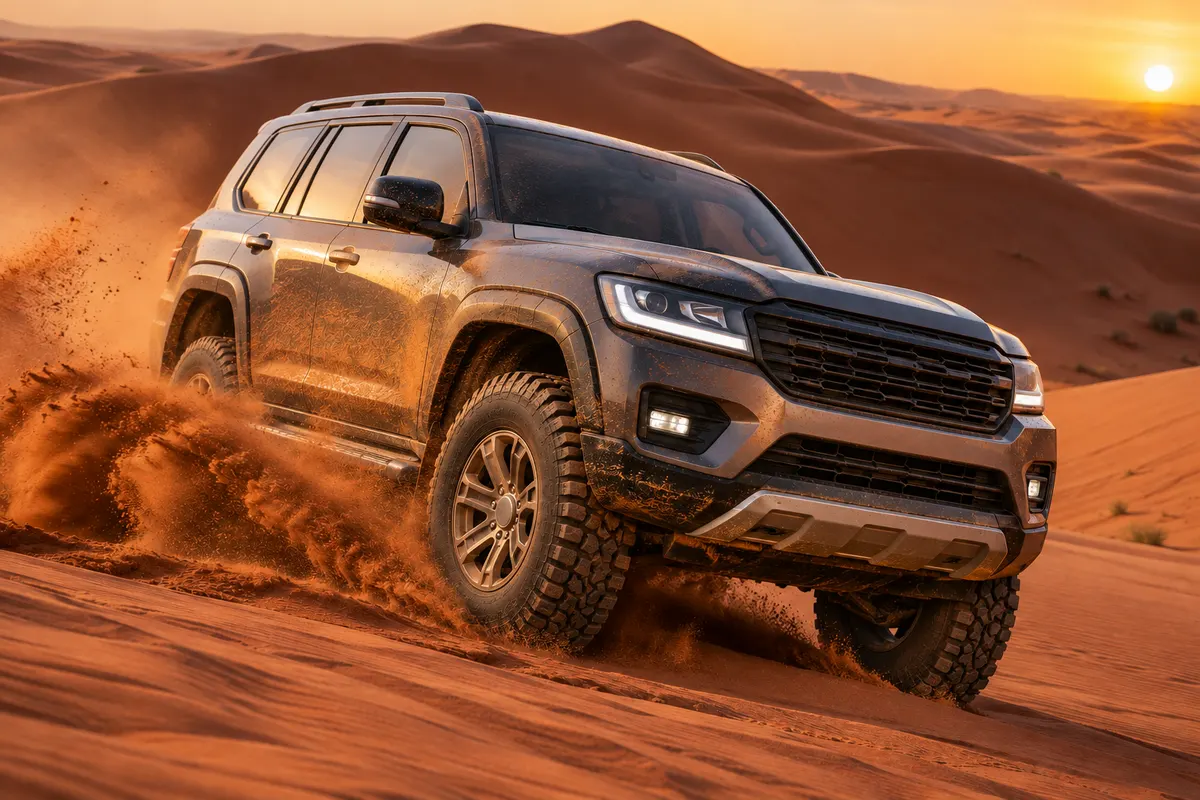
A good desert tyre has a strong, flexible sidewall, a tread that does not dig in too aggressively, and a construction that tolerates running at low pressure without overheating. Sand driving is about flotation. You want the tyre to spread out and sit on top of the sand, not cut into it like a spade. That is why pressure and sidewall design matter more than deep, chunky tread blocks.
The second requirement in the UAE is that the same tyre must cope with the drive there and back. Most people heading to Liwa, Al Faya or the Big Red area cover 100 km or more of motorway at 120 km/h first. A tyre that is brilliant in sand but noisy and vague on tarmac is a poor fit for most owners.
The third is heat resistance. Sand surface temperatures in summer easily pass 60°C, and a tyre flexing at low pressure builds up its own heat on top of that. Load rating matters too, because a loaded Land Cruiser or Patrol with fuel, water and recovery gear is heavier than the brochure figure.
- Sidewall strength to resist cuts from rocks and gravel under the sand.
- Tread that cleans itself and does not dig in when you lose momentum.
- Construction rated for the weight of a loaded 4x4.
- Acceptable noise and stability at 120 to 140 km/h for the drive home.
Which Continental tyres work best in sand?
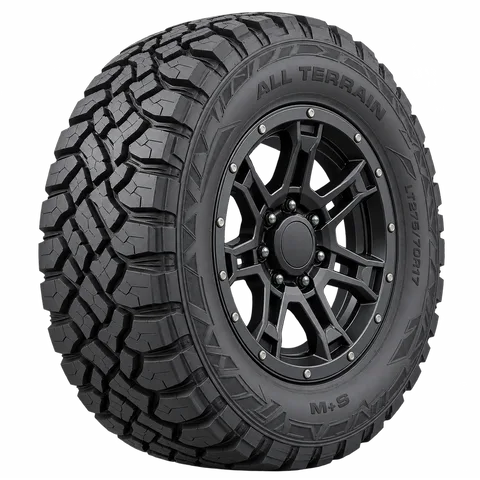
For regular desert driving, the TerrainContact A/T and the CrossContact ATR are the two Continental patterns I recommend first. Both are all-terrain tyres designed to handle loose surfaces while staying civilised on the road. For drivers who go off tarmac only now and then, the Conti4x4Contact and TerrainContact H/T are better suited.
- TerrainContact A/T: an all-terrain tread with a robust casing, good for regular dune trips and gravel tracks while staying quiet enough for daily driving.
- CrossContact ATR: a road-biased all-terrain tyre with an open shoulder, well suited to SUVs that split time between motorway and sand.
- Conti4x4Contact: a comfortable highway tyre for large 4x4s that handles graded desert roads and light sand, not deep dunes.
- TerrainContact H/T: a highway-terrain tyre for pickups and large SUVs that spend most of their life on tarmac.
- CrossContact LX2: a long-life SUV tyre for drivers who rarely leave the road, with enough toughness for farm tracks and car park sand.
TerrainContact A/T or CrossContact ATR: which one suits you?
Choose the TerrainContact A/T if you go to the dunes most weekends in the cooler months or drive gravel wadi tracks in Hatta and Ras Al Khaimah. Its tread and casing are aimed at mixed off-road use, so it shrugs off more abuse. I fit it mostly to Land Cruisers, Patrols, Wranglers and pickups that see real off-road use.
Choose the CrossContact ATR if the desert is an occasional trip and most of your driving is the school run, office and motorway. It is quieter and more road-focused, so it suits a Prado, Pajero or Fortuner that goes to the sand a handful of times a season.
If you never leave the tarmac except for a sandy car park, neither is necessary, and a highway tyre will be quieter, cheaper and longer-lasting. That is the honest answer I give customers who ask for an all-terrain tyre mainly because it looks tougher. Our off-road 4x4 tyres page compares the patterns by vehicle, and the Continental off-road tyres page lists sizes and typical prices.
What tyre pressure should I run in the sand?
Most UAE 4x4 drivers get the best results in soft sand at around 15 to 18 PSI, down from the 30 to 36 PSI shown on a typical door placard. Lowering the pressure lengthens the contact patch so the tyre floats instead of digging. Start at 18 PSI and only go lower if the sand is very soft and the vehicle keeps bogging down.
I do not recommend going much below 15 PSI on a standard rim unless you are with an experienced group and know your vehicle. At very low pressures the tyre can roll off the bead in a sharp turn on a dune face, and it is a long recovery job in the heat.
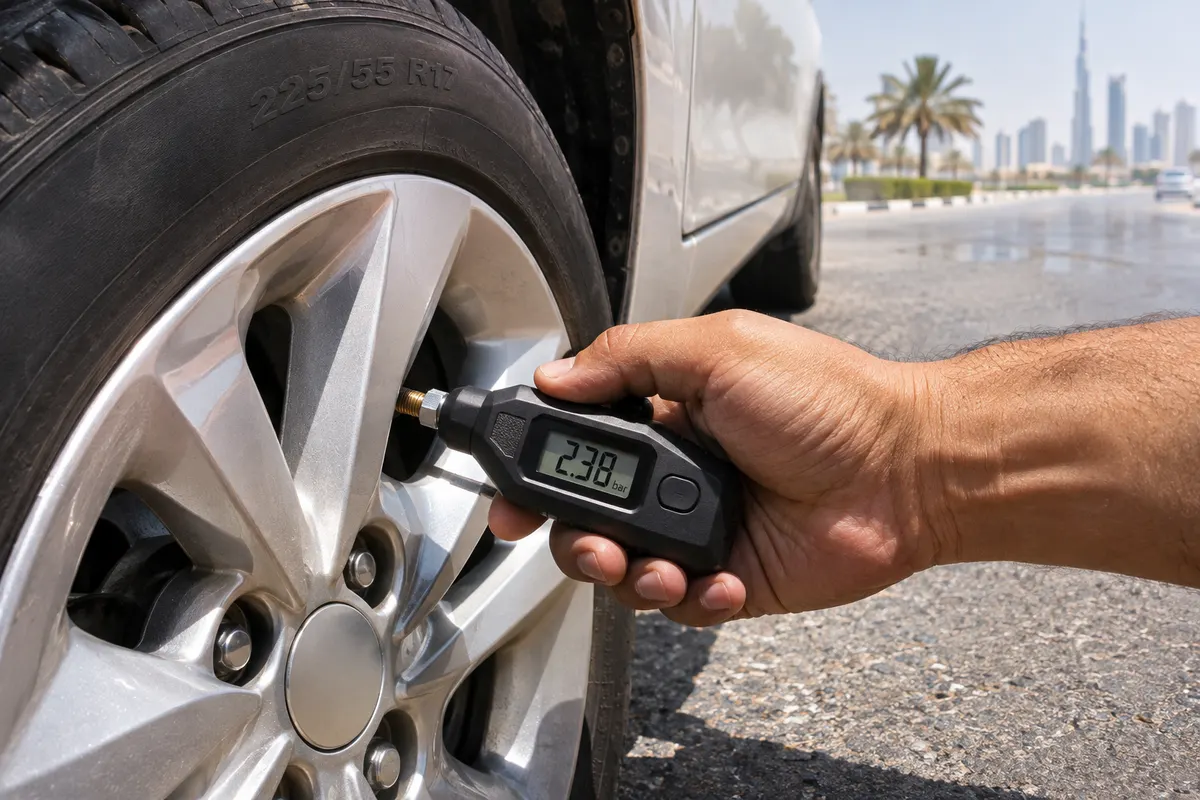
The most important step comes at the end. Re-inflate to the door-placard pressure before you drive back on tarmac. A tyre at 16 PSI driven at 100 km/h flexes far more than it was built to, heats up quickly and can fail without warning. My UAE summer tyre pressure guide explains how heat changes the reading, and a quick tyre pressure check after a trip is worth it if you do not carry a gauge.
- Air down at the edge of the sand, not on the motorway hard shoulder.
- Use a proper gauge rather than guessing by eye.
- Keep speed low, under about 40 km/h, while running sand pressure.
- Carry a 12V compressor rated for large 4x4 tyres, so re-inflating does not take an hour.
- Re-inflate to placard pressure before you rejoin the road.
How does desert heat affect 4x4 tyres?
Heat speeds up every form of tyre damage, and in the UAE desert it comes from both the ground and the tyre itself. Sand and asphalt in July and August can pass 60 to 70°C at midday. A tyre running low pressure flexes more with each rotation, and that flexing generates internal heat. Put the two together and the rubber and casing work much harder than they do on a cool winter morning.
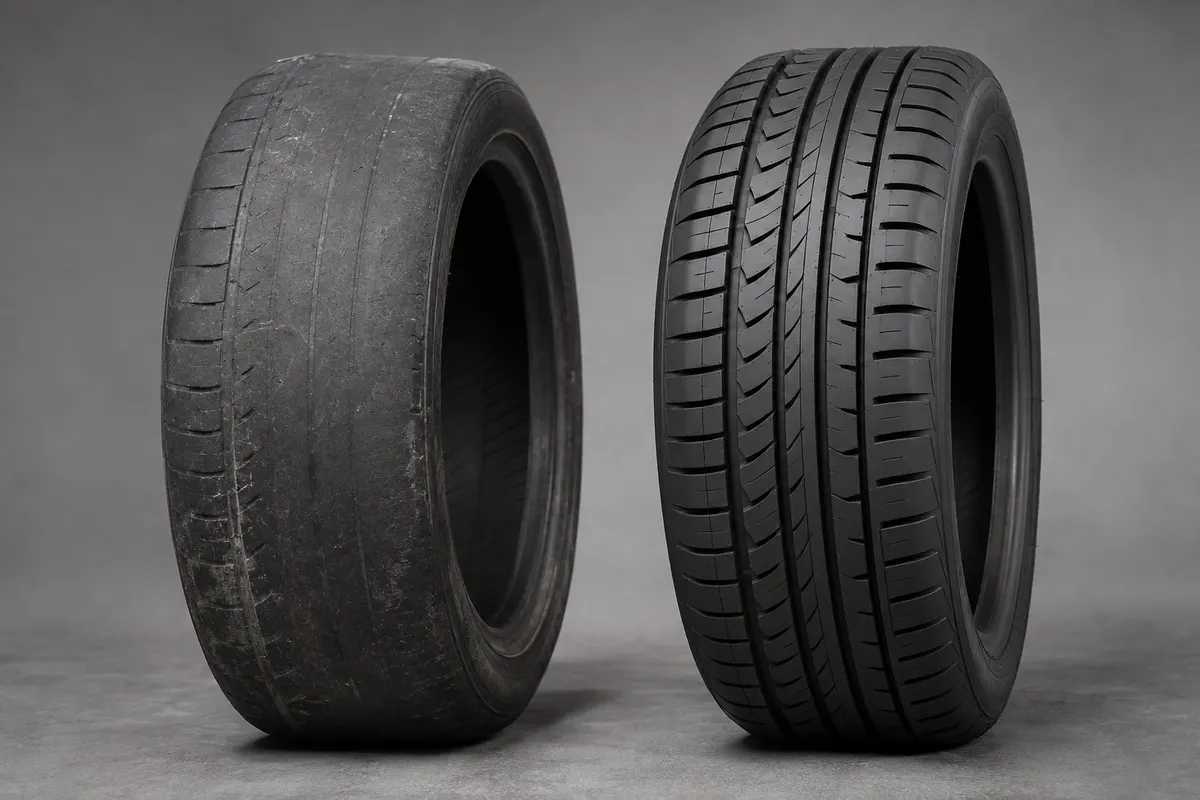
This is why I see more sidewall separations and bulges from summer desert trips than winter ones, even though fewer people go out in summer. It is also why I tell customers to check the DOT date on desert tyres carefully. An older tyre has less flexibility left in the rubber, and tyres more than five years past their DOT date are commonly rejected at inspection anyway.
If you do drive in the sand in summer, go early in the morning, keep the load sensible, and give the tyres time to cool before re-inflating, because a hot tyre will read higher and you may under-fill it.
One more summer habit worth breaking is parking with the tyres aired down for lunch or a break in the sun. The tyre is still carrying the full weight of the vehicle at low pressure with no airflow to cool it. If you stop for a long break, park in shade where you can, and check the sidewalls before you set off again. On the way home, stop at the first fuel station with an air line if your compressor is slow, rather than driving the motorway at sand pressure to reach a familiar one.
Do I need a dedicated off-road tyre if I only visit the dunes a few times a year?
If you go to the desert only a few times a year and spend the rest of the time in the city, you do not need a dedicated off-road tyre. A good highway or SUV tyre, aired down correctly and driven with care, will handle a guided dune drive or a weekend at a desert camp. What you give up is some margin. A highway tyre has a thinner sidewall and a tread designed for water, not sand, so you need to be more careful with pressure and with rocks.
The trade-off works the other way too. An all-terrain tyre fitted to a city SUV that never leaves the tarmac is slightly noisier on the motorway, uses a little more fuel and may wear faster on hot asphalt. When customers ask, I look at how they really drive rather than how they would like to drive. If the honest answer is two or three desert trips a season, I usually suggest a highway tyre such as the CrossContact LX2 or TerrainContact H/T, and a compressor and gauge in the boot. If it is most weekends from October to April, an all-terrain tyre pays for itself in fewer cuts and less stress.
- Mostly tarmac, a few desert trips a year: highway or SUV touring tyre.
- Regular weekends in the sand: all-terrain tyre.
- Rocky wadis and mountain tracks as well as sand: all-terrain tyre with a strong load rating.
Which Continental desert tyre sizes fit popular UAE 4x4s?
The sizes I fit most for desert use are the factory sizes of the Land Cruiser, Patrol, Prado and Wrangler. Availability of each pattern varies by size, so always confirm the exact model and load rating for your vehicle before ordering.
- Toyota Land Cruiser 200 and 300: 265/65 R17, 285/60 R18, 265/55 R20.
- Nissan Patrol Y62: 265/70 R18, 275/60 R20.
- Toyota Prado: 265/65 R17, 265/60 R18.
- Jeep Wrangler: 245/75 R17, 255/70 R18.
- Toyota Hilux and Fortuner: 265/65 R17, 265/60 R18.
How should I check my tyres after a desert trip?
After every dune day, check each tyre for sidewall cuts, bulges, embedded stones and sand around the bead before your next motorway drive. Most desert damage is not visible from the driver's seat, and a small cut on the inner sidewall can grow into a failure at highway speed later that week.
I suggest a simple routine at home or in the building car park the next morning. Turn the steering to full lock so you can see the inside face of the front tyres. Run a hand carefully along the tread to feel for stones. Check the pressure on all four tyres, plus the spare, with the tyres cold. If one tyre keeps losing pressure, sand under the bead or a damaged valve is a common cause.
If you find a bulge or a cut that shows the cords, the tyre needs replacing, not repairing. My guide on when to replace tyres in the UAE covers the signs in more detail. For bigger SUVs, our best Continental SUV tyres guide compares the full range if you are not sure an all-terrain is right for you.
- Look for bulges, cuts and cracks on both sidewalls.
- Remove embedded stones from the tread grooves.
- Check pressures cold and compare all four.
- Wash sand off the wheels and valves.
- Get the alignment checked if the steering wheel is now off centre.