Short answer
Most tyre damage falls into four groups: sidewall bulges from impacts, cuts, cracking from heat and age, and uneven wear from pressure or alignment faults. A bulge, a cut showing cords or deep cracking means the tyre must be replaced. A small puncture in the central tread can usually be repaired, but never one in the shoulder or sidewall.
Key takeaways
- A sidewall bulge means the internal cords are broken. The tyre cannot be repaired and should be replaced before the next long drive.
- Fine surface crazing is common on older tyres in the UAE sun, but cracks you can push a fingernail into are a replacement sign.
- Wear in the centre points to overinflation, wear on both edges to underinflation, and wear on one shoulder usually to alignment.
- Punctures are generally repairable only in the central tread area, and only if the hole is small and the tyre was not driven flat.
- Fixing the cause matters as much as fixing the tyre: a new tyre on a car that is out of alignment will wear the same way.
Most of the tyres I condemn in Dubai, Abu Dhabi and Sharjah are not worn out. They come off because of a bulge after a speed bump taken at 40 km/h, a gash from a kerb in a tight mall car park, or a web of cracks on a tyre that has spent four summers parked in the sun. The tread can be at 5 mm and the tyre still be finished.
In four years of fitting and inspecting tyres in the UAE I have learned to read damage quickly, and to explain it to customers who are understandably reluctant to replace a tyre that looks nearly new. This guide covers what each type of damage means, what can be repaired, and what has to be replaced.
What causes a sidewall bulge?
A sidewall bulge is caused by an impact that breaks the cords inside the tyre, letting air pressure push the rubber outwards into a lump. The most common causes I see in the UAE are speed bumps taken too fast, sharp kerbs in car parks, potholes on older industrial roads and the hard edge where a basement ramp meets the floor.
The impact pinches the tyre between the object and the wheel rim. The rubber on the outside often looks undamaged, but one or more of the body ply cords inside has snapped. Once that happens there is nothing holding the air pressure back at that point except a thin layer of rubber.
Low-profile tyres are the most vulnerable. A 35 or 40 series tyre on a 20-inch rim has very little sidewall to absorb a hit, and I replace more bulged tyres on German saloons and large SUVs on big wheels than on any other cars. Underinflation makes it worse, because a soft tyre squashes further on impact.
The important point is that a bulge cannot be repaired. There is no patch or plug that restores broken cords. A bulged tyre can fail suddenly, especially at highway speed in summer heat, so I tell customers not to take it on the E11 or E311 at all. Drive gently to a safe place or fit the spare, and book a tyre replacement.
- Speed bumps at speed, especially the tall ones in residential areas
- Kerb strikes while parking or turning in tight car parks
- Potholes and broken road edges
- Basement ramp lips and raised drain covers
- Running a tyre underinflated, which makes any impact worse
Are cuts in a tyre dangerous?
A cut in a tyre is dangerous if it is deep enough to show the cords or fabric underneath, or if it is in the sidewall. Shallow scuffs in the outer rubber, such as the marks left by brushing a kerb, are usually cosmetic.
The way I judge a cut is simple. If I can see threads, steel or fabric at the bottom of it, the tyre is finished. If the cut is in the sidewall and deeper than a light surface scratch, I also replace it, because the sidewall flexes on every rotation and a cut there tends to grow. In the tread, a small cut that has not reached the belts can be left, but I keep an eye on it.
In the UAE, many cuts come from debris on hard shoulders: broken metal, stones and glass that collect where sand blows across the road. If you pull onto the shoulder on a highway, slow right down and check your tyres afterwards. Sharp-edged gravel on construction diversions also causes chunking, where small pieces of tread are torn out. Light chunking is mostly cosmetic; deep chunks that expose belts are not.
What do cracks in a tyre mean?
Cracks in a tyre mean the rubber is drying out and hardening, usually through a combination of age, heat and UV exposure. In the UAE this happens faster than in cooler climates, because cars sit in direct sun at 45–50°C air temperature and tyres on the sunny side of the car can get far hotter than that.
There are two kinds of cracking. Fine surface crazing, a pattern of shallow lines on the sidewall or between tread blocks, is common on tyres a few years old and is not on its own a reason to panic. Deeper cracks, ones you can push a fingernail into, cracks at the base of the tread grooves or cracks that run around the circumference near the rim, mean the rubber has lost its strength and the tyre should be replaced.
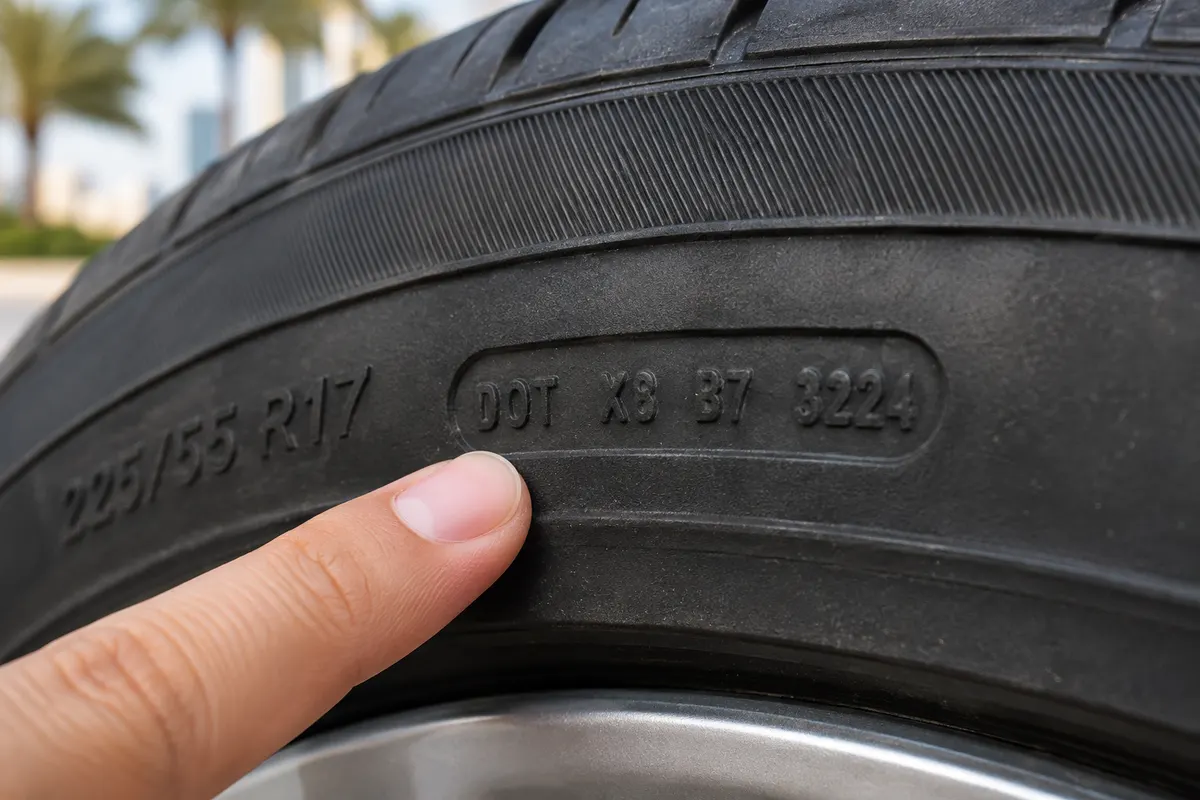
Age is closely linked. Rubber ages whether the tyre is used or not, which is why a spare or a tyre on a weekend car can crack with full tread. Tyres more than five years past their DOT date are commonly rejected at inspection. My guide to reading the DOT date code shows how to find the age in a few seconds.
To slow cracking down, park in shade or a covered car park where you can, keep pressure correct, and avoid tyre shine products that contain solvents. Plain water and mild soap are enough.
| What you see | Likely cause | What I recommend |
|---|---|---|
| Lump or bulge on the sidewall | Impact broke internal cords (speed bump, kerb, pothole) | Replace the tyre. Not repairable |
| Cut showing cords or fabric | Sharp debris, kerb strike | Replace the tyre |
| Fine surface crazing | Age, heat and UV | Monitor. Check DOT date |
| Deep cracks in grooves or sidewall | Advanced ageing, long sun exposure | Replace the tyre |
| Wear in the centre of the tread | Overinflation | Set pressure to door-placard value |
| Wear on both edges | Underinflation | Correct pressure and check for slow leaks |
| Wear on one shoulder | Alignment (camber or toe) | Wheel alignment before new tyres |
| Patchy dips (cupping) | Worn shocks or poor balance | Check suspension and wheel balance |
| Nail or screw in central tread | Road debris | Usually repairable after internal inspection |
| Nail in shoulder or sidewall | Road debris | Replace the tyre |
What does uneven tyre wear tell you?
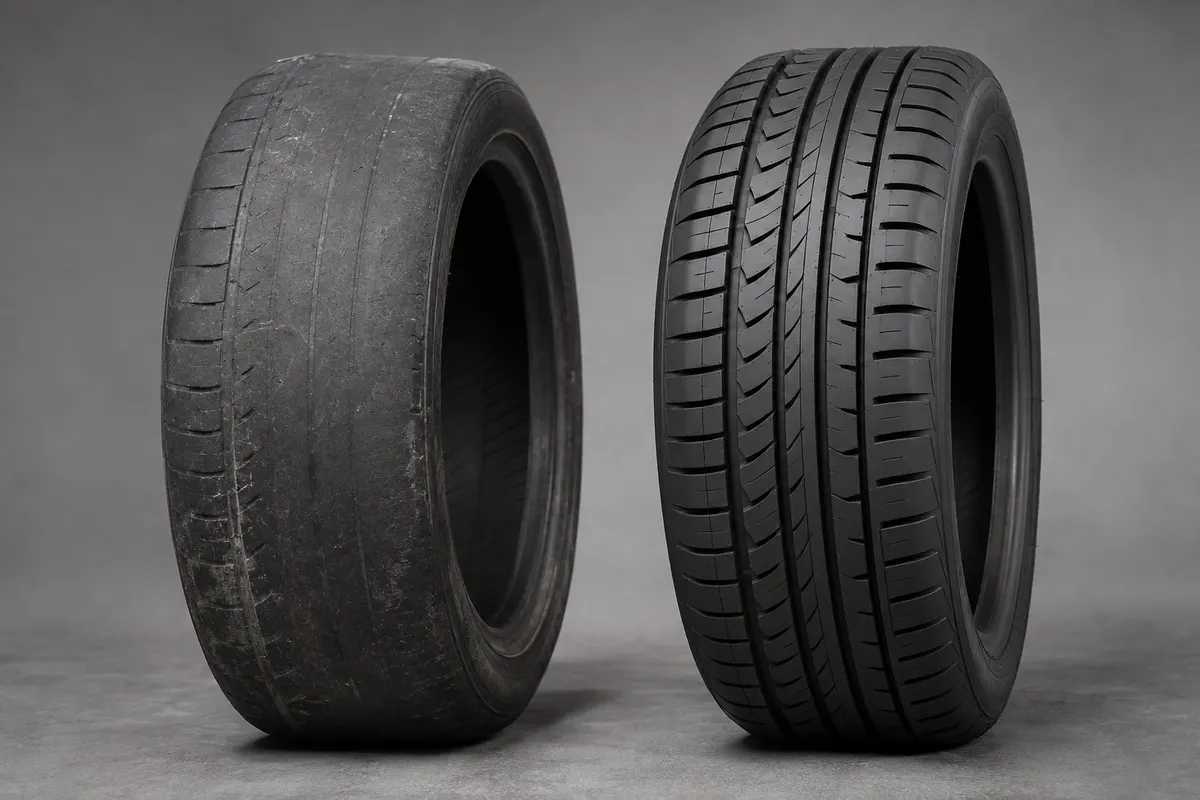
Uneven tyre wear tells you something on the car is wrong, usually pressure or wheel alignment, and the pattern points to which one. Reading wear is one of the most useful checks I do, because it lets me fix the cause and not just the symptom.
Wear in the centre of the tread means the tyre has been running overinflated. Wear on both outer edges means it has been running underinflated, which is far more common in the UAE because pressure is rarely checked and drops slowly over weeks. Wear on one shoulder only, usually the inner edge, points to alignment: too much camber or toe, often after a hard kerb or pothole strike.
Feathering, where the tread blocks are smooth on one side and sharp on the other when you run a hand across them, is another toe problem. Cupping, patchy dips around the tyre, often points to worn shock absorbers or a wheel out of balance. The table below summarises the patterns I see most.
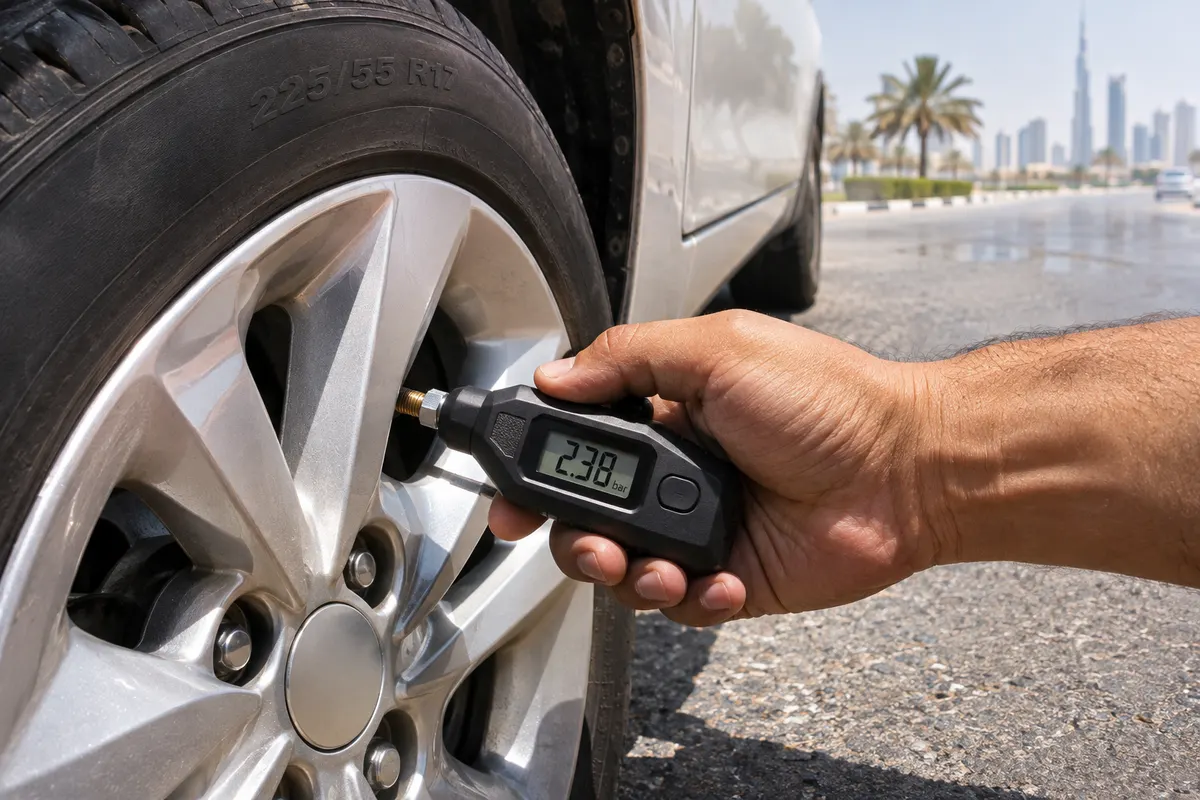
If you see one-sided wear, have a wheel alignment check before fitting new tyres. I have seen a brand new set lose 3 mm on the inner edge in a few months on a car with bent alignment. Pressure is the easier fix: set it cold to the door-placard value and check every two weeks in summer. The tyre pressure guide for UAE summer explains how.
When can a puncture be repaired?
A puncture can usually be repaired if it is in the central tread area, the hole is small, and the tyre has not been driven flat. Industry guidance generally limits repairs to holes of around 6 mm in diameter in the main tread, away from the shoulders, and to one or two repairs that are well spaced apart.
The shoulder and sidewall are not repairable. Those areas flex too much for a repair to hold, and a plug in the shoulder can work loose at speed. If a screw has gone in at the edge of the tread where it starts to curve down, the tyre needs replacing even though the hole looks tiny.
Driving on a flat tyre is the other common reason a repair is refused. Even a few hundred metres flat can crush the inner sidewall, and the damage shows as a ring of rubbing or powdery rubber inside the tyre. That is why a proper repair means taking the tyre off the rim and inspecting the inside, not just pushing a plug in from outside. Our puncture repair service works that way.
Run-flat tyres follow stricter rules. Many carmakers and tyre makers advise against repairing an SSR tyre that has been driven in run-flat mode, because the internal heat damage cannot be seen. I cover this in more detail in Continental run-flat SSR tyres explained.
- Repairable: small hole, central tread, tyre not driven flat, no other damage
- Not repairable: shoulder or sidewall, hole larger than about 6 mm, long cuts
- Not repairable: tyre driven flat with internal damage, overlapping old repairs
- Check first: run-flat tyres driven in deflated mode
When should a damaged tyre be replaced?
A damaged tyre should be replaced when it has a bulge, a cut showing cords, deep cracking, a puncture outside the repairable area, or internal damage from being driven flat. It should also be replaced when the tread reaches 1.6 mm, which is the legal minimum, or when it is around five years past its DOT date. The federal traffic fine for unfit tyres is AED 500 and 4 black points.
If only one tyre is damaged and the others are fairly new, replacing one is fine on most two-wheel-drive cars, ideally with the same model so the axle stays matched. On all-wheel-drive cars the difference in tread depth between the new and old tyres matters more, which I explain in can you mix tyre brands, models or run-flat and standard tyres. For the full checklist on tread and age, see when to replace tyres in the UAE.
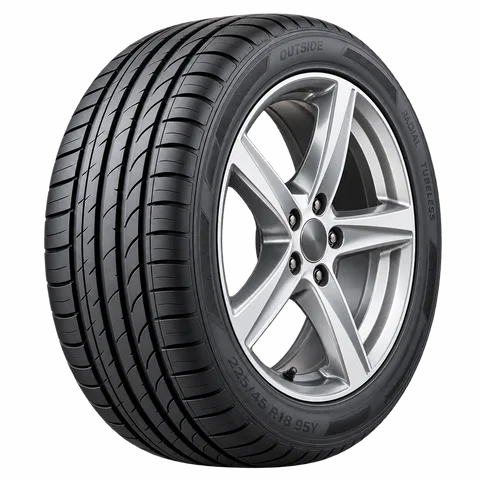
For a like-for-like replacement, the PremiumContact 7 is a common choice on sedans and premium saloons, the UltraContact UC7 on everyday family cars, and the CrossContact LX2 on SUVs that stay on tarmac.
How can I reduce tyre damage in the UAE?
The best way to reduce tyre damage in the UAE is to keep pressure correct, slow right down for speed bumps and ramps, and inspect your tyres once a month. Most of the damage I see is avoidable.
Correct pressure protects against both impacts and heat. A tyre at the door-placard value holds its shape over a speed bump; one that is 8 PSI low folds and pinches. Take speed bumps at walking pace and at a right angle where possible, and keep a little distance from kerbs when you park, especially on large wheels.
Once a month, walk round the car and look at each sidewall and the tread. Run your hand across the tread to feel for feathering. Look for lumps, cuts and nails. If anything looks wrong, we can come to your home or office, check it and replace the tyre on the spot with our mobile tyre fitting service in Dubai, or arrange an alignment at a partner workshop.