Short answer
Most UAE summer tyre blowouts are caused by underinflation, which makes the sidewall flex and overheat on roads that reach 60 to 70°C. Overloading, tyres more than five years old, existing damage and sustained high speed add to the risk. Check cold pressures weekly, keep to the load rating and replace aged or damaged tyres.
Key takeaways
- Underinflation is the number one cause of summer blowouts, because a soft tyre flexes more and builds heat fast.
- Never let air out of a hot tyre in summer. Check and set pressure cold, to the door-placard value.
- Overloading, old rubber and sidewall damage from kerbs or speed bumps all lower the safety margin.
- Sustained speeds of 120 to 140 km/h on the E11 or E311 add heat, so the tyre's speed rating and condition matter.
- If a tyre blows, hold the wheel straight, ease off the accelerator and do not brake hard.
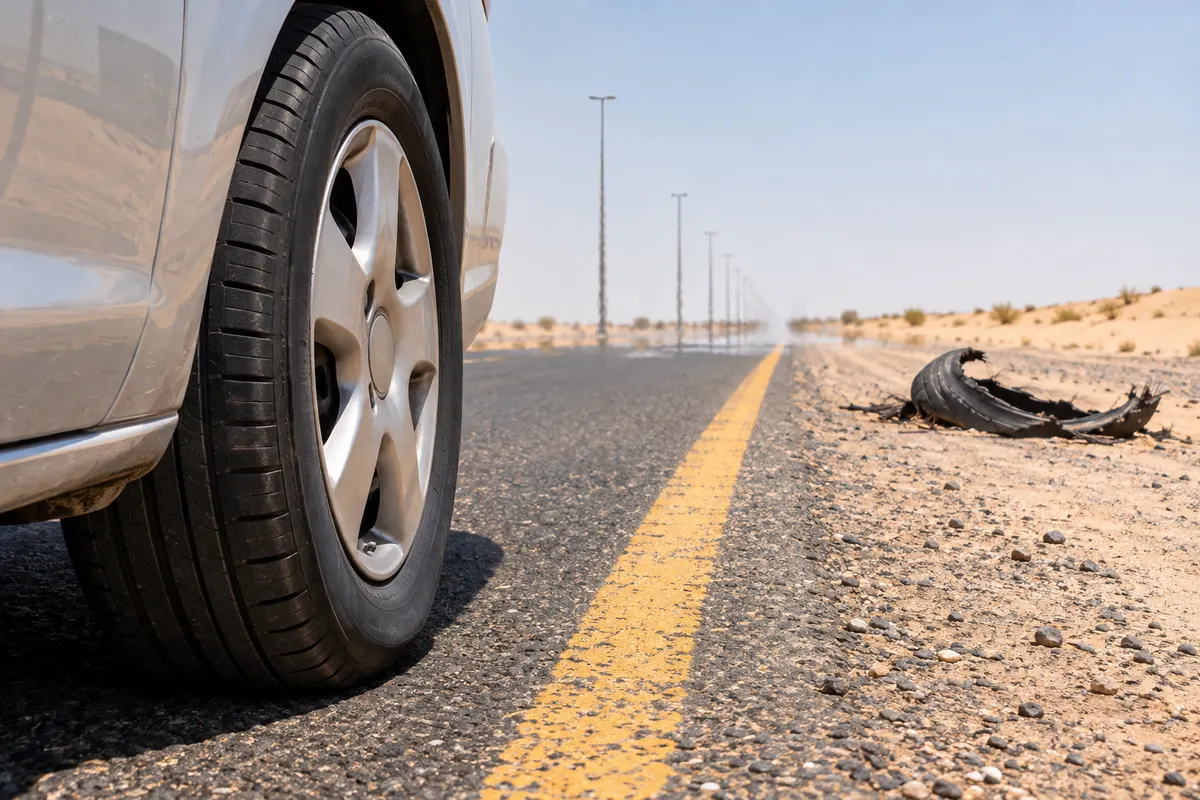
Summer is the busiest time of year for roadside call-outs, and blowouts are a big part of that. In four years of fitting tyres in the UAE, I have attended plenty of burst tyres on the E11, the E311 and the Abu Dhabi to Al Ain road, and when I look at what is left of the tyre, the cause is usually clear. A shredded inner sidewall points to low pressure. A clean split near the shoulder often points to an old bulge. A tyre that looks cooked on a family SUV loaded for a road trip tells its own story.
The good news is that most blowouts are preventable. This guide explains why tyres fail in UAE heat and gives you the checklist I use myself before a long summer drive.
What causes a tyre blowout in UAE summer?
A tyre blowout happens when the casing overheats or weakens to the point that it suddenly cannot hold the air pressure, and summer in the UAE pushes tyres closer to that point than anywhere I have worked. Road surfaces in July and August reach 60 to 70°C at midday. The tyre heats up from the road below and from its own flexing as it rolls, and rubber and the bond between the layers inside the tyre both weaken as temperature rises.
Heat on its own rarely causes a blowout in a healthy tyre. A good Continental tyre at the correct pressure is designed to cope with those temperatures. What heat does is turn a small problem, such as low pressure, a forgotten bulge, an aged spare or an overloaded boot, into a failure. That is why prevention is mostly about removing those small problems before the hottest months.
- Underinflation, the most common cause by far.
- Overloading beyond the tyre's load index.
- Old tyres with hardened, brittle rubber.
- Existing damage from kerbs, potholes or speed bumps.
- Sustained high speed, especially with any of the above.
Why is underinflation the biggest blowout risk?
An underinflated tyre flexes much more each time it rotates, and that extra flexing generates heat inside the sidewall faster than the tyre can shed it. At motorway speed a tyre rotates many times per second, so even a modest pressure drop adds up quickly. Eventually the inner layers separate, and the tyre fails.
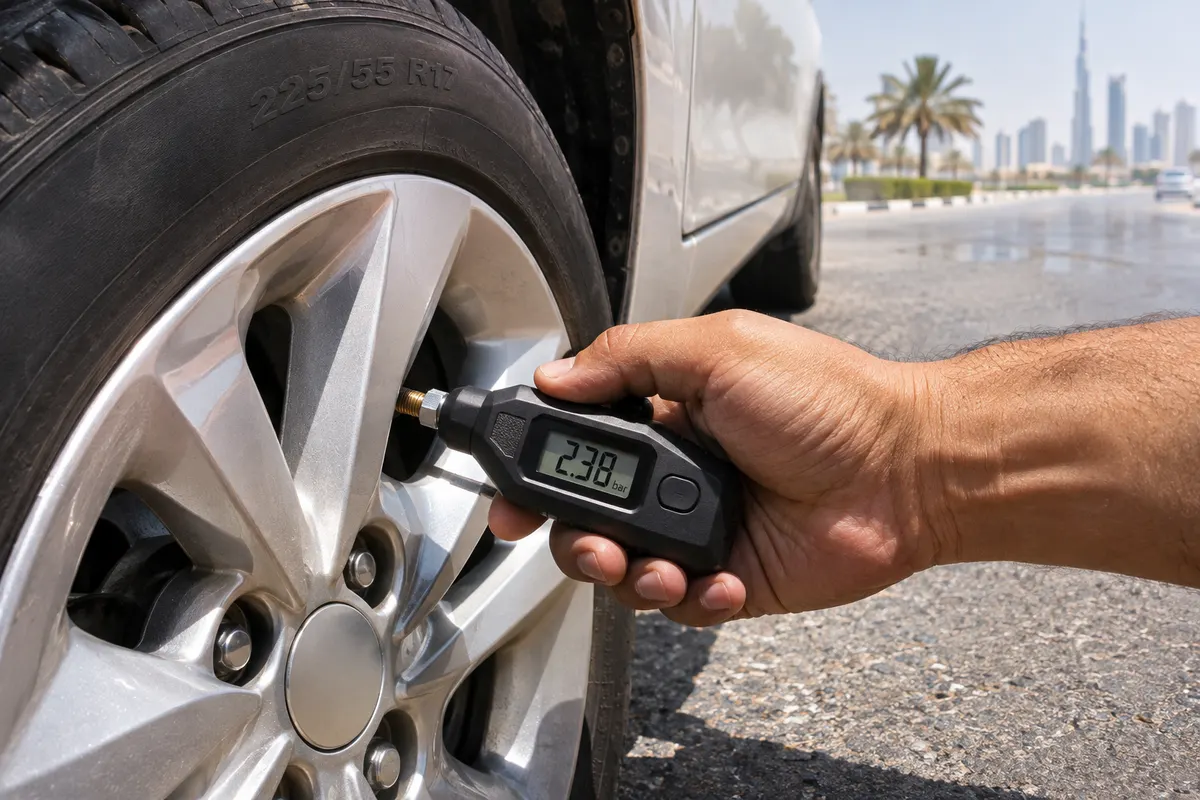
The trap in the UAE is that pressure readings rise as the tyre heats. A tyre that is 6 PSI low when cold can read close to normal after half an hour of driving in the sun. People check at a petrol station after driving, see a normal number, and think all is well. Others let air out because the hot reading looks too high, which leaves the tyre underinflated once it cools.
Always check pressure cold, ideally first thing in the morning or after the car has been parked in the shade for a few hours, and set it to the value on the driver's door placard, not the maximum printed on the sidewall. My summer tyre pressure guide explains this in detail, and we offer a tyre pressure check at your location if you do not have a gauge.
Slow leaks are part of the same story. A nail in the tread can lose a few PSI a week, which is easy to miss if you only check once a month. If one tyre is always lower than the others, have it inspected for a puncture rather than topping it up and hoping. A small tread puncture is usually repairable, and it is much cheaper to fix than a tyre destroyed by driving on it soft.
Does overloading a car cause tyre blowouts?
Yes, carrying more weight than the tyres are rated for increases flexing and heat in the same way that low pressure does. Every tyre has a load index on the sidewall, such as 100 or 112, which corresponds to the maximum weight it can carry at the correct pressure. Four adults, luggage for a week and a roof box on a mid-size SUV can come closer to the limit than people expect.
I see this most on summer road trips to Oman or the east coast, and on pickups and vans carrying work equipment. If you load the car heavily, check the door placard or owner's manual for the higher laden pressure, which is often a few PSI more than the normal figure. On SUVs and 4x4s, make sure replacement tyres carry at least the original load index. Our SUV tyres page lists typical sizes and the load ratings that go with them.
Vans and MPVs used for school runs or staff transport are another case. They often run close to their maximum load every day, and a tyre with the wrong load index, or a passenger car tyre fitted instead of a reinforced one, has very little margin in summer.
Are old tyres more likely to blow out?
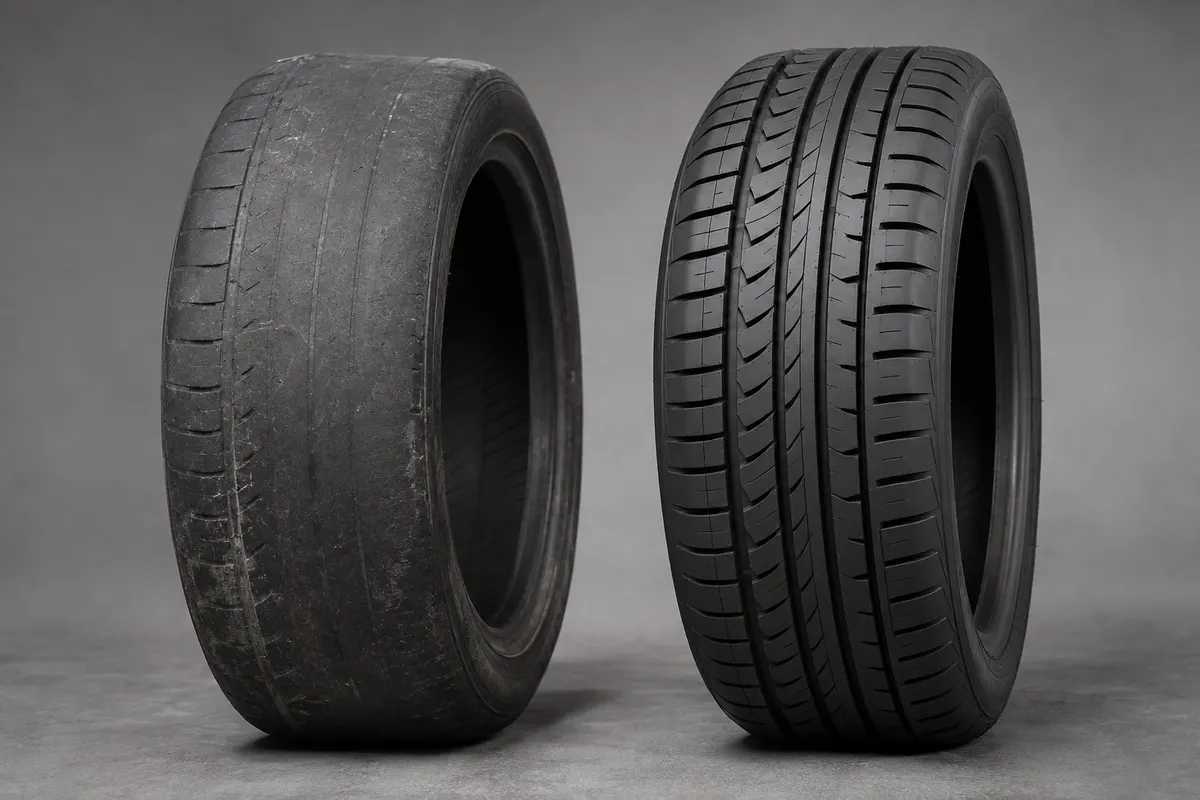
Old tyres are more likely to fail in heat because aged rubber loses flexibility and the internal bonds between layers weaken over time. Tyres more than five years past their DOT date are commonly rejected at inspection in the UAE, and I would treat that as the point to replace in this climate, regardless of tread depth.
The tyres I worry about most are the ones that look fine. A car that does low mileage, or a weekend 4x4, can have deep tread on tyres that are seven or eight years old. The spare is often the oldest tyre on the car and is rarely checked at all. Look for fine cracks in the sidewall and between tread blocks, which are a sign the rubber is drying out. Tyres on cars parked outside all day in the sun age faster than those kept in a covered car park, so the same DOT date can mean a different condition. When I replace a set, I always look at the spare too, and in summer I suggest replacing an old spare at the same time if it is cracked, so the one tyre you rely on in an emergency is not the weakest.
My guide on when to replace tyres in the UAE covers age, tread depth and the fine for unfit tyres.
How do speed and heat combine on the E11 and E311?
Sustained high speed adds heat to a tyre, so a long run at 120 to 140 km/h in July puts far more stress on it than the same distance in town. Speed increases the rate of flexing, and on a long straight motorway the tyre never gets a chance to cool down. That is why so many blowouts happen on the long intercity roads rather than in city traffic. The Dubai to Abu Dhabi run, the drive to Al Ain and the long stretches towards Ruwais and the Saudi border are where I see the most heat-damaged tyres, usually in the afternoon.
Every tyre has a speed rating, the letter after the load index, such as H for 210 km/h, V for 240 km/h or Y for 300 km/h. Fit at least the rating the car came with. A healthy tyre at the right pressure will cope with UAE motorway speeds comfortably. The risk comes when an underinflated, overloaded or aged tyre is asked to do it.
For regular long-distance drivers, a durable touring tyre like the PremiumContact 7 or, for SUVs, the CrossContact LX2, gives you a good margin of heat resistance and tread life.
What should I check before a long summer drive?
Before any long summer drive, check cold pressures, tread depth, sidewalls, DOT dates and the spare. It takes ten minutes and covers most of the causes of blowouts I see. This is the routine I follow on my own car.
- Check all four tyres and the spare when cold, and set them to the door-placard pressure, using the laden figure if the car is full.
- Look along both sidewalls for bulges, cuts and cracks. Turn the steering to full lock to see the inside of the front tyres.
- Check the tread depth across the width. Replace below about 3 mm, and never drive below 1.6 mm.
- Read the DOT date on every tyre. Plan replacement for anything around five years old.
- Check the load index and do not exceed it. Spread weight evenly and avoid overloading the roof.
- Plan stops on long drives, especially in the afternoon heat, and walk round the car to look at the tyres.
What should I do if a tyre blows out at speed?
If a tyre blows out, hold the steering wheel firmly and straight, ease off the accelerator gradually and do not brake hard. A sudden pressure loss makes the car pull towards the damaged tyre, and braking hard or steering sharply at that moment is what causes the car to spin or roll.
Let the car slow down on its own, then brake gently once you are below about 60 km/h. Indicate and move as far to the right as safely possible, onto the hard shoulder. Switch on hazard lights, get everyone out on the side away from traffic and stand behind the barrier if there is one. Do not try to change a wheel in a live lane. If the spare is the space-saver type, remember it is rated for a lower speed, usually 80 km/h, and is meant only to get you to a safe place or a fitter.
Once you are safe, you can call for help. We provide 24-hour Continental tyre replacement across Dubai, Abu Dhabi and Sharjah, with arrival usually within 30 to 60 minutes in city areas. Roadside fitting starts from AED 100 per visit.
Can run-flat or ContiSeal tyres prevent a blowout?
Run-flat and ContiSeal tyres reduce the danger after a puncture, but they do not remove the main causes of a heat-related blowout. A run-flat tyre has a reinforced sidewall that supports the car for a limited distance after losing pressure. ContiSeal is a sealant layer inside the tread that can close small punctures from nails and screws, so the tyre keeps its pressure.
Both help because a slow puncture that goes unnoticed is one route to an underinflated, overheating tyre. But neither protects against chronic underinflation, overloading, old rubber or a bulge. Run-flats also rely on a working tyre pressure monitoring system so you know you are running flat. Treat them as an extra layer of safety, not a replacement for regular checks.
If your car has a tyre pressure monitoring system, use it as an early warning, not a reason to skip manual checks. Most systems only warn after a significant drop, which in summer can already be enough to cause trouble at motorway speed. A faulty sensor is also worth fixing, because a car that shows a permanent warning light teaches the driver to ignore it.