Short answer
A Continental tyre warranty covers defects in materials or manufacturing, not wear or road hazard damage such as punctures, cuts and kerb impacts. In the UAE, terms are set by Continental's regional distributor and a claim is decided by their inspection of the tyre. Keep the invoice, the DOT code and the tyre itself.
Key takeaways
- Manufacturer warranties cover defects in materials and workmanship; punctures, cuts, impact bulges and normal wear are road hazard or use issues.
- Warranty terms vary by market and are set by Continental's regional distributor, so ask for the UAE terms in writing when you buy.
- The distributor's inspection of the actual tyre decides a claim; the seller cannot approve it on the spot.
- Keep the invoice showing size, pattern and DOT code, keep the tyre, and take photos before anything is changed.
Warranty questions usually come up at the worst moment, standing next to a car with a bulged sidewall on the hard shoulder. In my four years fitting tyres around the UAE, most of the tyres people hoped were faulty turned out to have impact damage from a pothole, kerb or speed bump, and those are not manufacturing defects. Genuine defects do happen, though, and when they do, the paperwork you kept decides how smoothly the claim goes.
We are an independent retailer and fitter, not Continental and not the distributor, so we do not set or approve warranty terms. What I can do is explain how tyre warranties generally work, what tends to be covered, and how to collect the evidence a distributor needs.
What does a Continental tyre warranty cover?
A Continental tyre warranty covers defects in materials and workmanship, meaning faults that come from how the tyre was made rather than how it was used. Examples include tread or belt separation that is not caused by impact or under-inflation, a bead that will not seat correctly on a good rim, or irregularities in the structure that show up early in normal use.
Continental's own warranty pages for other markets describe the same principle. Its Malaysia FAQ, for example, says the warranty covers tyre conditions related to the manufacturing process, and that a tyre inspector appointed by Continental decides whether a condition is manufacturing-related. Its global information says that in most markets the minimum warranty is two years, depending on local law, and some markets tie the period to the production date or the purchase date.
I have not found published Continental warranty terms specific to the UAE, so I will not quote a number of years or kilometres here. Ask for the current UAE terms in writing when you buy, and keep them with the invoice.
When you ask, get answers to four questions: how long the cover lasts, whether it runs from the production date or the purchase date, whether there is a minimum tread depth for a claim, and whether any replacement is full or pro-rata. Those four points decide what a warranty is actually worth to you.
What is not covered by a tyre warranty?
Road hazard damage, normal wear and damage from incorrect use are not manufacturing defects, so they are generally not covered by a manufacturer's warranty. This is where most disappointed claims come from.
It helps to think about what the tyre went through rather than what it looks like now. A tyre does not develop a bulge on its own after months of normal use; something broke the cords inside, and in the UAE that is nearly always a kerb, a sharp-edged speed bump or a pothole at speed. Likewise, a tyre that wore out early on one edge was being pushed at an angle by the suspension, not let down by its rubber.
The common exclusions I see in practice:
- Punctures from nails, screws and debris, which are very common near construction sites.
- Sidewall bulges caused by hitting a kerb, pothole or speed bump; the internal cords break on impact.
- Cuts and chips from gravel shoulders, rocks and sharp edges.
- Damage from driving flat or badly under-inflated, which leaves a crease or powdered rubber inside the tyre.
- Uneven wear from misalignment, worn suspension or skipped rotation.
- Normal tread wear down to the 1.6 mm indicators.
- Incorrect fitting, mismatched sizes, racing, or use outside the load and speed rating.
How can you tell a defect from impact damage?
A bulge with a mark or graze on the rim or sidewall at the same spot is almost always impact damage, while a defect tends to show up without any outside mark and often affects the tread area or the structure evenly. That is a rule of thumb, not a ruling; the inspector decides.
When I remove a tyre that a customer thinks is faulty, I look at three things. The outside of the sidewall, for scuffs or a pinch mark lined up with a mark on the rim edge. The inside liner, for a crease line or crumbled rubber that shows the tyre was run flat. And the wear pattern across the tread, which tells me about pressure and alignment history.
In UAE car parks, impact bulges are common on low-profile tyres, because 35 and 40 series sidewalls give little protection from the edge of a speed bump taken at an angle. If you drive a car with 19 or 20 inch wheels, taking bumps slowly and straight saves you more money than any warranty.
There are also problems that look like defects but are not. A vibration at 100 to 120 km/h is usually wheel balance, not the tyre, and is fixed by rebalancing. A pull to one side after new tyres can be alignment, or occasionally a tyre characteristic that swapping the front tyres side to side will reveal. A slow air loss is often a valve or a corroded rim seat rather than the tyre itself. I check these first, because they are quick to fix and do not need a claim.
| Problem | Typically covered by manufacturer warranty? | Why |
|---|---|---|
| Tread or belt separation with no impact or under-inflation signs | Possibly, after inspection | May be a manufacturing defect |
| Sidewall bulge with matching rim mark | Usually not | Impact damage from kerb, pothole or speed bump |
| Nail or screw puncture | No | Road hazard |
| Crease or crumbled rubber inside the tyre | No | Driven flat or badly under-inflated |
| One edge worn down | No | Alignment or suspension issue |
| Tread worn to 1.6 mm | No | Normal wear |
Who decides a Continental warranty claim in the UAE?
A warranty claim is decided by Continental's regional distributor after inspecting the tyre, not by the shop that sold or fitted it. The distributor examines the physical tyre, checks the DOT code and purchase records, and decides whether the condition is a manufacturing defect.
This matters for two reasons. First, the tyre must be kept and handed over for inspection; a tyre thrown away at the roadside cannot be claimed. Second, if a claim is accepted, the outcome is set by the distributor's terms, which may be a replacement or a credit that reflects the tread already used, rather than a free new tyre.
Terms vary by market because each region's distributor sets them. A tyre bought abroad, or through a channel that does not issue a proper invoice, can be harder to claim in the UAE. That is one reason to buy from a seller who records the DOT on the invoice; our page on Continental tyre dealers in Dubai explains what to ask for.
Claims also take time. The tyre has to be collected, inspected and assessed, so plan on being without that tyre while the process runs. That is why I suggest fitting a replacement straight away rather than leaving the car off the road while you wait for a decision.
What records should you keep for a tyre warranty claim?
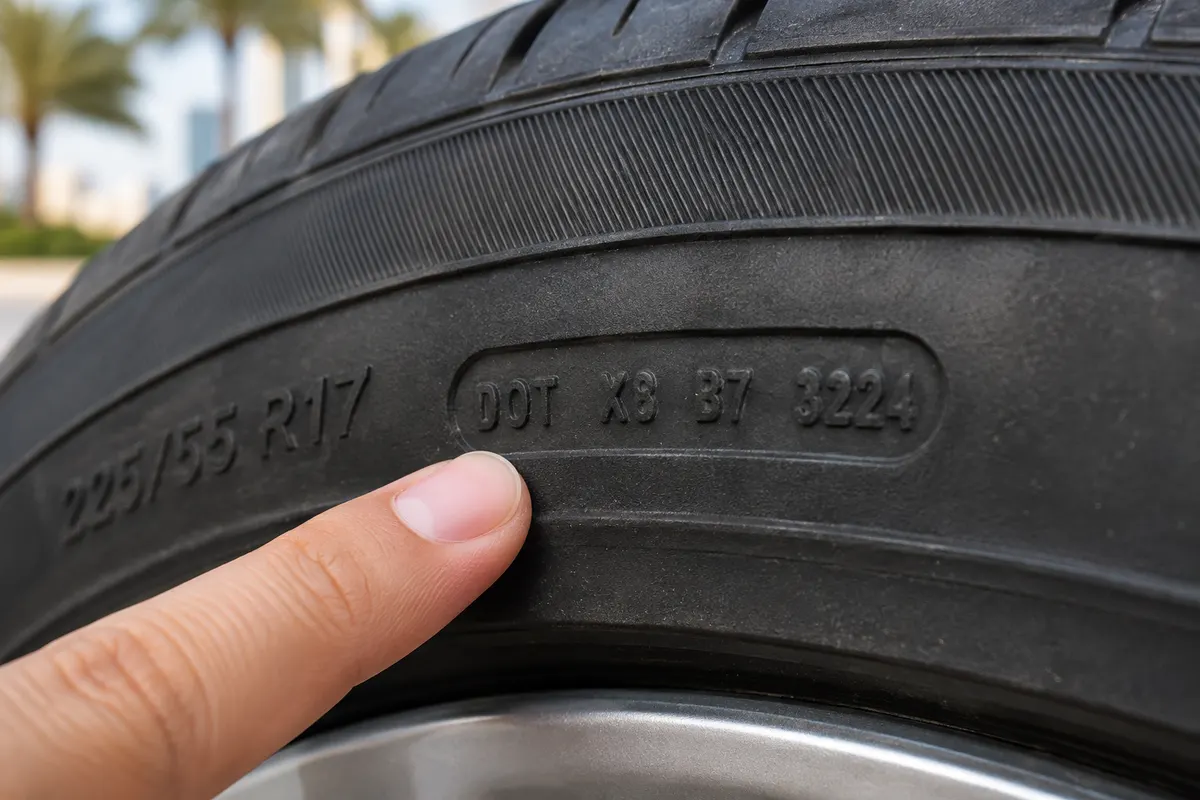
Keep the invoice that shows the tyre size, pattern, DOT code and date of purchase, because without proof of purchase and the DOT code a claim usually cannot start. The code also tells the distributor where and when the tyre was made; my guide to the Continental tyre DOT date code explains each part.
The file I suggest keeping, on your phone if not on paper:
- The invoice, with size, pattern, load and speed index, and the DOT code of each tyre.
- A photo of each tyre's DOT code taken at fitting.
- The odometer reading at fitting and at the time of the problem.
- Records of rotation, alignment and pressure checks, even a simple note.
- Clear photos of the problem area before the tyre is removed, plus one of the wheel rim at the same spot.
- The tyre itself, kept clean and dry until the claim is decided.
What should you do if a tyre fails on the road?
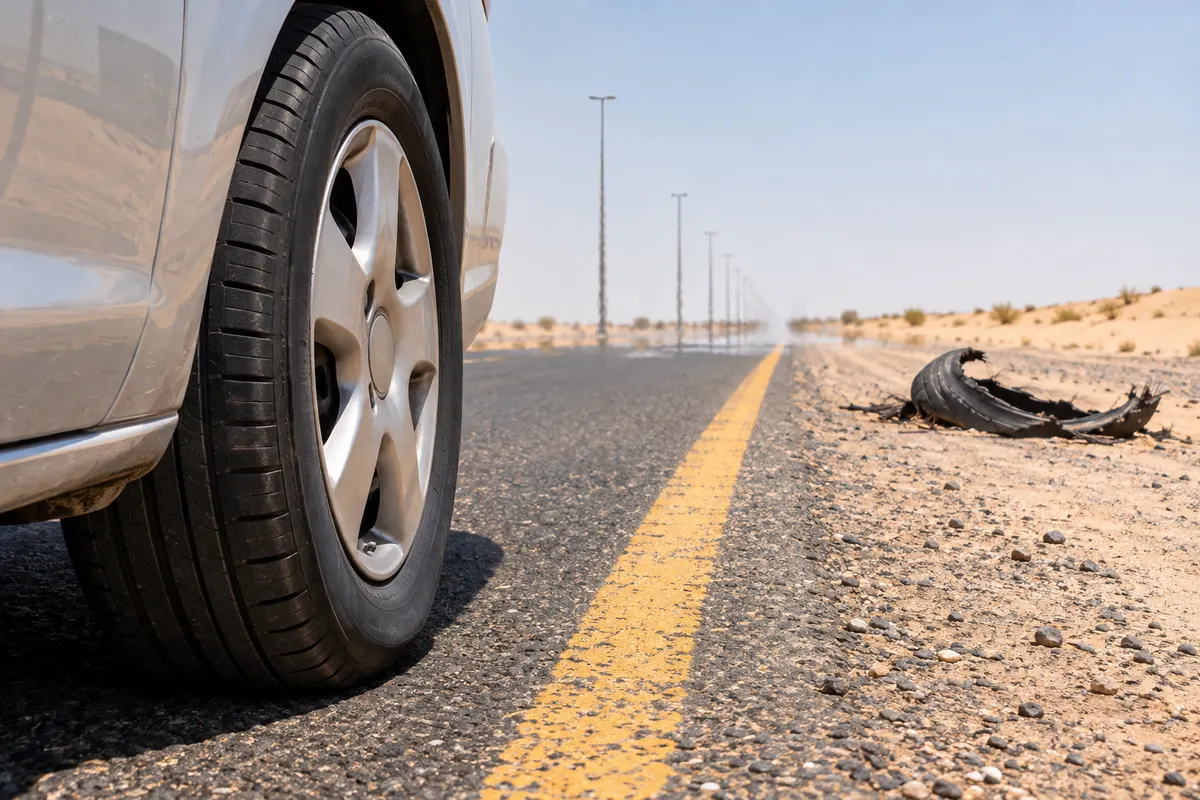
If a tyre fails while driving, hold the steering straight, ease off the accelerator without braking hard, and pull over to a safe spot as far from traffic as you can. Your safety comes before any warranty claim.
Once the car is stopped and you are safe, a few minutes with your phone protects your options later:
- Photograph the tyre on the car from several angles, including the damaged area and the wheel rim next to it.
- Photograph the DOT code on the sidewall if it is facing outwards.
- Note the date, time, location and odometer reading.
- Do not keep driving on a flat tyre; it destroys the inner structure and turns a possible claim into clear run-flat damage.
- Keep the tyre after it is changed. Ask the fitter to return it to you or hold it for inspection.
- If a spare is fitted, check its pressure and speed limit before continuing.
How do we help when you think a tyre is faulty?
When a customer suspects a defect, we help collect the evidence and pass it on; we do not decide the claim. Our invoices record the size, pattern and DOT code of every tyre we fit, and before fitting we show the customer the DOT code, so the starting record is already there.
If you report a problem, I photograph the tyre on the car, remove it, record the tread depth across the width and note any marks on the rim. We keep the tyre for inspection and fit a replacement or your spare so you are not stuck, which you pay for in the normal way; any outcome from the claim follows the distributor's decision.
For a puncture or road damage that is not a warranty matter, the fastest fix is usually a flat tyre repair if the hole is in the repairable tread area, or a replacement if it is in the shoulder or sidewall.
Is it worth buying road hazard cover for tyres?
Road hazard cover is a separate product from the manufacturer's warranty, offered by some sellers or insurers, and it is worth considering mainly for low-profile and run-flat tyres where a single impact bulge is expensive. It is not part of the Continental warranty.
Before paying for it, read what it excludes, whether it pays a pro-rata amount based on tread used, and whether you must use a particular fitter. For a 16 inch tyre costing AED 300 to 480, it rarely makes sense. For a 20 inch SportContact 7 or a 21 inch SUV tyre such as the CrossContact RX, both costing well over AED 1,000, it can.
Whatever you choose, the best protection is still cheap: correct pressure, slow speed bumps and an alignment check after any heavy hit. Our article on preventing tyre blowouts in UAE summer covers the habits that avoid most damage in the first place.
One more point on run-flat tyres: they are built to keep going for a limited distance at reduced speed after losing pressure, but driving on them beyond the distance and speed the car maker specifies damages the structure. If your run-flat warning comes on, follow the limits in the car's handbook and have the tyre checked the same day.