Short answer
An OE (original equipment) marking is a short code moulded on the sidewall showing that a carmaker tested and approved that exact tyre version for its cars. On Continental tyres, MO means Mercedes-Benz, ★ means BMW, AO means Audi, N0 to N2 means Porsche, LR means Land Rover, VOL means Volvo and T0 means Tesla.
Key takeaways
- An OE marking means the carmaker signed off a specific build of that tyre, often with a different compound, construction or noise treatment from the unmarked version.
- MO, MOE and MO-S (Mercedes), ★ (BMW), AO and RO1 (Audi), N0 to N2 (Porsche), J and LR (Jaguar Land Rover), VOL (Volvo) and T0 (Tesla) are the codes I see most on Continental tyres in the UAE.
- A marked tyre is not a legal requirement, but on Porsche, BMW run-flat and Tesla fitments the marking makes a real difference to how the car drives.
- Never mix marked and unmarked tyres on the same axle, and ideally match all four.
- Marked tyres usually cost a little more and stock is tighter, so confirm the exact code before ordering.
In four years of fitting tyres in Dubai, Abu Dhabi and Sharjah, one of the most common questions I get at the van is about the letters after the size. A customer with a Mercedes GLE reads "MO" on the old tyre, sees nothing like it on a cheaper quote, and wants to know if it matters. A BMW owner asks why the star is there at all. The short answer is that the marking tells you the carmaker approved that exact tyre build, and on some cars that matters more than people think.
This guide covers the OE markings you will actually find on Continental tyres, what each one means, when I tell customers to insist on it, and how to find the right code for your car before you order.
What does an OE marking on a tyre mean?
An OE marking is a code moulded into the sidewall that shows a carmaker has tested and homologated that specific version of the tyre for its vehicles. OE stands for original equipment, the tyres a car leaves the factory on. When a manufacturer like Mercedes-Benz or BMW develops a new model, it works with tyre makers such as Continental for several years to tune the tyre to that car's weight, suspension, steering feel and noise targets.
The result is often a tyre that looks identical to the retail version but is built slightly differently. The compound may be adjusted for grip or rolling resistance, the casing may be stiffer to suit a heavier SUV, or the inside may carry a foam layer to cut cabin noise. The marking is how you tell the two apart. Two tyres can both read 275/45 R20 on the sidewall and still behave differently on the same car because one is marked and one is not.
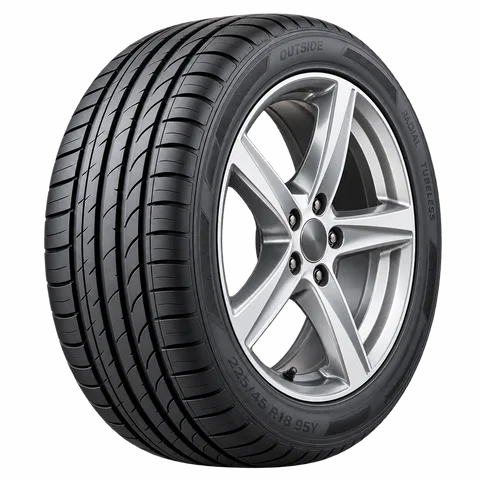
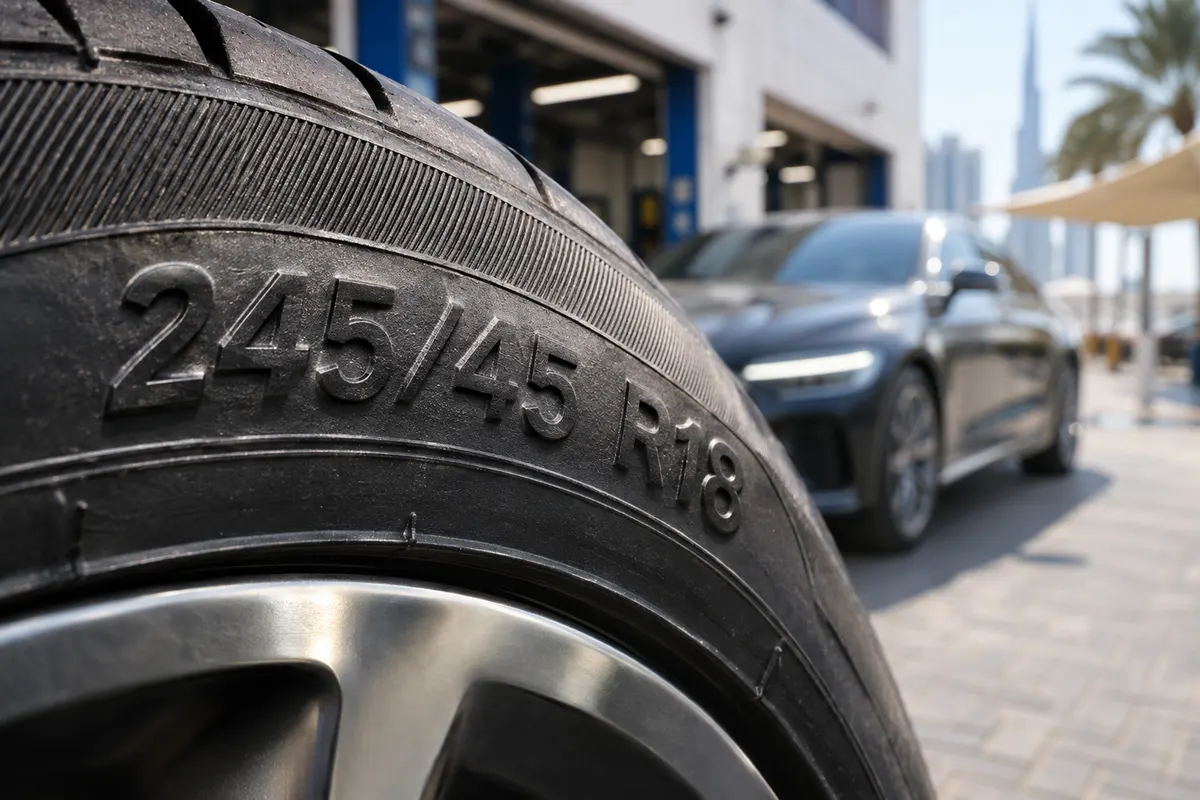
You will usually find the code right after the load and speed index, for example 245/45 R18 100Y XL ★ or 255/50 R20 109W XL MO. It is small, so I tell people to look with a torch in a dark basement car park rather than squinting at it in the midday sun.
Which OE markings appear on Continental tyres?
Continental uses a set of carmaker codes that it lists on its own original equipment pages, and the ones below are the markings I have verified for Continental fitments. The table further down summarises them. In the UAE the ones I fit most often are MO and MOE for Mercedes, the star for BMW, AO for Audi, N0 to N2 for Porsche, LR for Land Rover and T0 for Tesla.
The same pattern can carry different markings in different sizes. A SportContact 7 might be available as an MO1 for an AMG in one size and an N1 for a Porsche in another. A PremiumContact 7 may come as an unmarked retail tyre and also as an approved version for a European saloon. That is why quoting by pattern name alone is not enough.
- MO: Mercedes-Benz approved.
- MO1: Mercedes-AMG approved, usually on high-performance sizes.
- MOE: Mercedes-Benz approved run-flat (extended mobility).
- MO-S: Mercedes-Benz approved with ContiSilent noise-reducing foam.
- ★ (star): BMW approved, also used on MINI.
- AO: Audi approved. RO1: Audi Sport and quattro high-performance models.
- N0, N1, N2 and up: Porsche approved, the number marks the generation of approval.
- J: Jaguar. LR: Land Rover. J LR: approved for both.
- VOL: Volvo. T0: Tesla. AR: Alfa Romeo. MGT: Maserati.
What is the difference between MO, MO1, MOE and MO-S?
All four are Mercedes-Benz approvals, but each one describes a different kind of tyre. MO is the standard Mercedes-Benz approval for regular models, from a C-Class to a GLE. MO1 is reserved for Mercedes-AMG, where the tyre is tuned for higher speeds, harder braking and more heat, which is why you see it on performance patterns like the SportContact range.
MOE means the tyre is a Mercedes-approved run-flat. The E stands for extended mobility, so the sidewall is reinforced to carry the car for a limited distance after a puncture. If your Mercedes came on MOE tyres it probably has no spare wheel, so swapping to a standard MO tyre means you lose that safety net. I explain this in more detail in my guide to Continental SSR run-flat tyres.
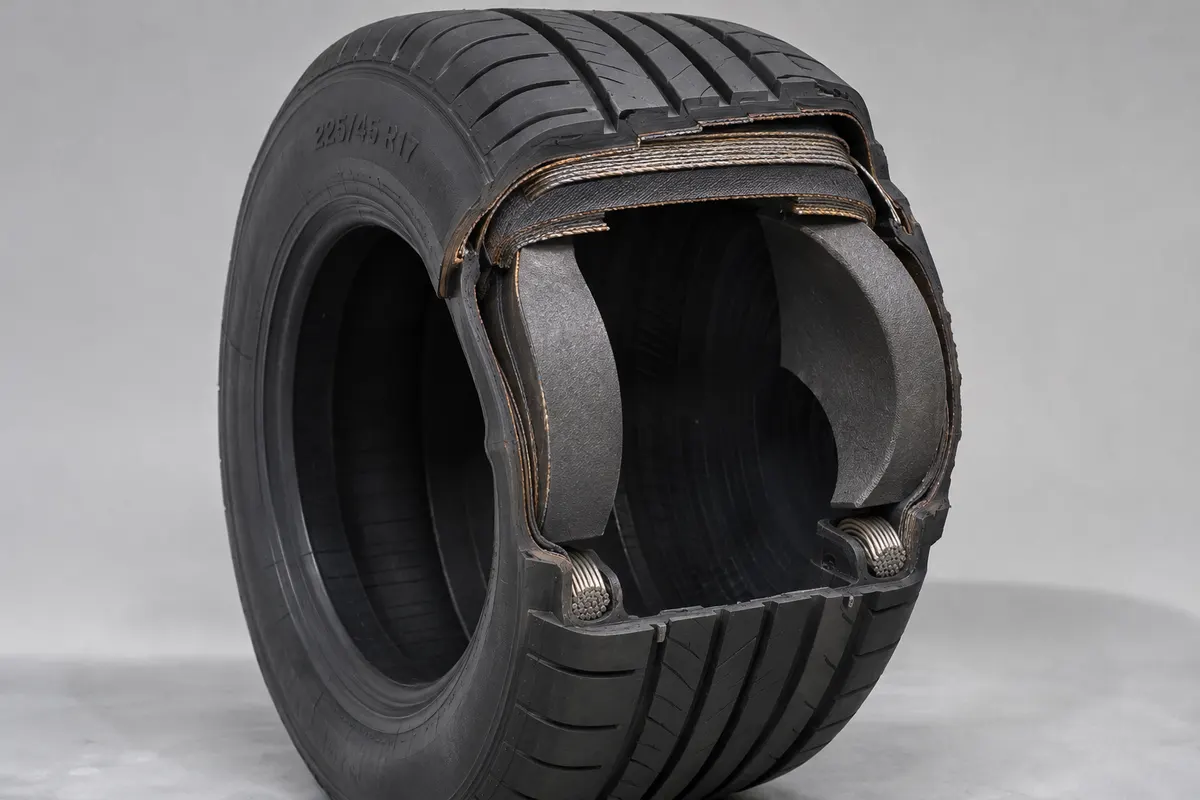
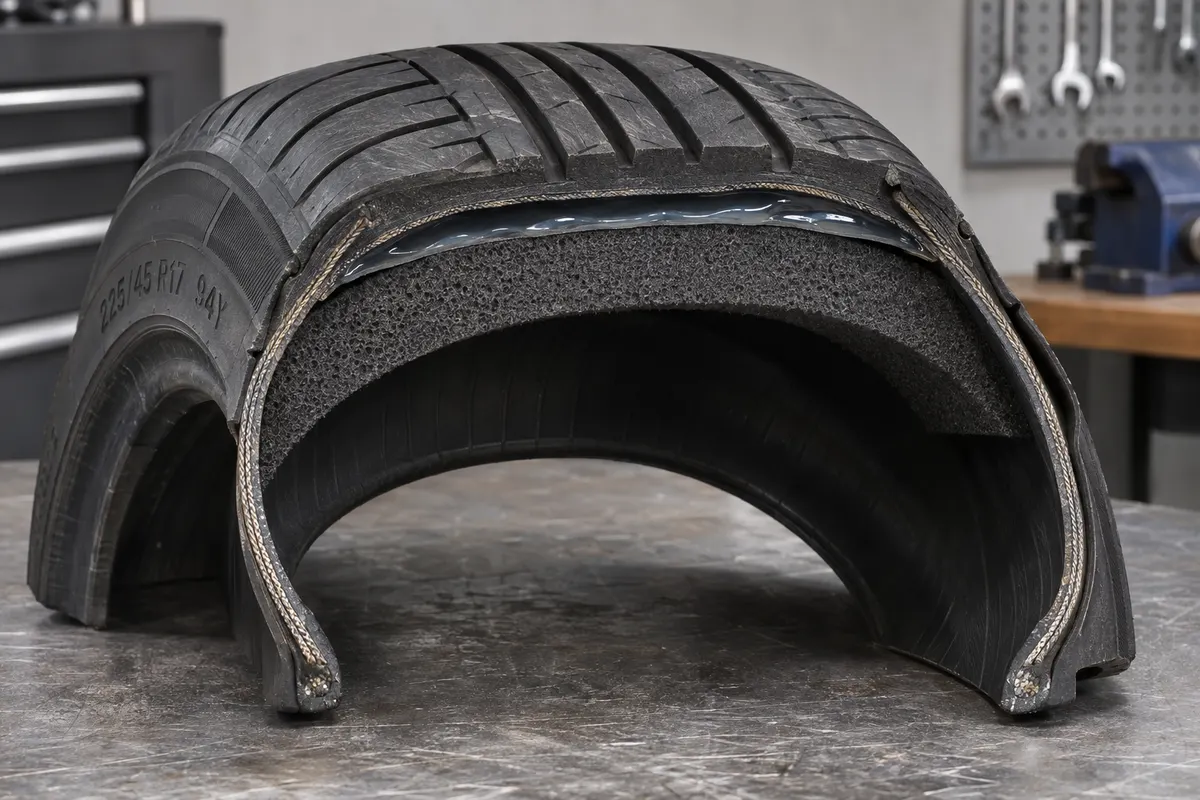
MO-S marks a Mercedes-approved tyre with ContiSilent, a polyurethane foam layer bonded inside the tread that absorbs cavity noise. It shows up mostly on EQ electric models and the larger saloons and SUVs, where there is no engine noise to mask road roar. The foam does not change how you fit the tyre, but it does need to be avoided when repairing a puncture from inside. My ContiSilent and ContiSeal explainer covers how that works.
| Marking | Carmaker | What it means |
|---|---|---|
| MO | Mercedes-Benz | Approved by Mercedes-Benz for its standard models |
| MO1 | Mercedes-AMG | Approved for AMG performance models |
| MOE | Mercedes-Benz | Approved run-flat with extended mobility after a puncture |
| MO-S | Mercedes-Benz | Approved version with ContiSilent noise-reducing foam |
| ★ (star) | BMW and MINI | Approved by BMW, often on run-flat fitments |
| AO | Audi | Approved by Audi for its regular models |
| RO1 | Audi Sport / quattro | Approved for high-performance Audi models |
| N0, N1, N2 | Porsche | Porsche approval, the number marks the generation |
| J | Jaguar | Approved by Jaguar |
| LR | Land Rover | Approved by Land Rover |
| J LR | Jaguar Land Rover | Approved for both Jaguar and Land Rover |
| VOL | Volvo | Approved by Volvo |
| T0 | Tesla | Approved by Tesla for its electric models |
| AR | Alfa Romeo | Approved by Alfa Romeo |
| MGT | Maserati | Approved by Maserati |
What does the star mean on BMW tyres?
The star symbol (★) means BMW has approved that tyre for its cars, and it is also used for MINI. Star marking is the BMW equivalent of MO for Mercedes, and on the UAE roads it is the code I am asked about most after MO.
Many BMWs here, especially the 3 Series, 5 Series, X5 and X6, leave the factory on star-marked run-flat tyres. On those cars the suspension is tuned around a stiff run-flat sidewall, and the car has no spare. Fitting an unmarked, non-run-flat tyre changes the ride and steering response, and it leaves you stuck on the hard shoulder of the E311 if you pick up a screw. When a BMW owner wants to switch away from run-flats for comfort, I explain the trade-off and make sure they understand they will need a repair kit or spare in the boot.
Some Continental sizes carry both the star and another code, for example ★ MO, meaning the same tyre was approved by both BMW and Mercedes. That is common on shared European sizes. If you drive a BMW, the Continental tyres for BMW page lists the sizes and run-flat options we usually supply.
Do Audi, Porsche, Land Rover, Volvo and Tesla markings matter as much?
The marking matters most on cars where the tyre is a large part of the chassis tuning, and Porsche, Audi Sport and Tesla are at the top of that list. For a Porsche, the N-marking is close to essential. Porsche approves tyres in generations, N0 for the first, N1 for the next and so on, and it recommends that all four tyres carry an N-marking, ideally the same one. I would not fit an unmarked performance tyre to a 911 or Cayenne in summer when road surfaces in Dubai reach 60 to 70°C.
Audi's AO covers the regular range and RO1 covers Audi Sport and the faster quattro models. On an RS model the RO1 tyre is built for the extra power and weight, so I always try to match it.
Land Rover's LR and Jaguar's J matter on the heavier models like the Range Rover and Defender, where load capacity and stability at 140 km/h on a loaded SUV are part of the approval. Volvo's VOL is less critical in day-to-day driving but still worth matching.
Tesla's T0 tyres are tuned for the weight and instant torque of an electric car, and many come with foam for noise. If you drive one, my notes on Continental tyres for Tesla explain which versions to look for.
Is it illegal or unsafe to fit a tyre without the OE marking?
Fitting an unmarked tyre in the correct size, load index and speed rating is not illegal in the UAE and does not, on its own, make the car unsafe. The law cares about size, load, speed rating, tread depth and condition, not the carmaker's approval code. A good unmarked Continental in the right specification is a safe tyre.
What changes is how close the car feels to the way the engineers set it up. On a family saloon like a Camry or Accord, which rarely comes on marked tyres anyway, there is nothing to worry about. On a BMW run-flat, an AMG or a Porsche, an unmarked tyre can feel softer, noisier or less precise, and on a few cars it can bring up warnings if the run-flat setting no longer matches.
The one rule I hold firm on is not to mix. Two different tyres on the same axle, even if both are Continental, can pull the car to one side under braking. If you cannot get four matching marked tyres, fit the same tyre across each axle at a minimum, and tell the technician so the pressures are set properly.
There is also a practical point about pressure. Run-flat and OE-marked tyres sometimes have their own recommended pressures listed in the owner's manual, especially on cars with a comfort and eco pressure setting. When I fit a different tyre to the original, I set the pressure to the door placard and, where the car allows it, reset the tyre pressure monitoring system so it learns the new baseline.
How do I find the OE marking my car needs?
The fastest way is to read the code on the tyres currently fitted, as long as they are the ones the car came with. Look after the load and speed index on the outer sidewall. If the tyres have been replaced before, they may not be the original spec, so it is worth checking a second source. A previous owner or a quick roadside replacement may have left you with an unmarked tyre on one corner, and copying that tyre would carry the mistake forward.
- Check the sidewall of all four tyres, front and rear, since staggered cars often have different sizes and markings on each axle.
- Look at the tyre placard on the driver's door pillar for the size and pressure, then match the marking to the original tyres.
- Send a clear photo of the sidewall on WhatsApp before ordering, so the exact size, load index, speed rating and marking can be confirmed.
- If the car is a staggered setup, such as many BMW, Mercedes and Porsche models, send photos of a front and a rear tyre, because the marking can differ between axles.
- When we arrive, ask to see the DOT code and the marking on the new tyre before it goes on the wheel. We show both as standard.
Does an OE-marked tyre cost more in the UAE?
An OE-marked Continental usually costs a little more than the unmarked version of the same size, and the gap is widest on performance and run-flat tyres. Marked tyres are made in smaller batches for specific cars, so stock is tighter and they sometimes need to be ordered in. On a common touring size the difference may be small. On a 20-inch star-marked run-flat or an N-marked SportContact it can be noticeable.
I tell customers to weigh it against the car. If the car is a performance or luxury model that was set up on marked tyres, the extra spend is part of keeping it driving the way it should. If the car came on unmarked tyres, there is nothing to gain by hunting for a code it never had. Our Continental tyre prices guide shows typical ranges by size, and it explains why marking is one of the reasons two quotes for the same size can differ. For more on how the marking fits into luxury car tyres generally, see our luxury car tyre page.